
Quick Answer
The Enhanced ACT English test (2026) draws on roughly 20 recurring grammar and punctuation rules across three categories: Conventions of Standard English (38–43% of questions), Production of Writing (38–43%), and Knowledge of Language (18–23%). The most frequently tested rules involve commas, semicolons, apostrophes, subject–verb agreement, verb tense, modifiers, and concision. Idiomatic expressions — a staple of older prep guides — are no longer tested. Master the rules on this list, and you have covered every concept the ACT can ask you about in its 50 questions.
Most ACT Grammar Guides Are Teaching a Test That No Longer Exists
Here’s something that should concern any family paying for test prep: most of the ACT grammar guides ranking at the top of Google right now were written for the old ACT. They still teach idioms — “opposed to,” “participate in,” “capable of” — as an essential rule category. The Enhanced ACT, which became the standard test in 2025, no longer tests idiomatic expressions at all. Students are memorizing preposition lists for questions that will never appear on their test.
David Greenhouse has spent more than 20 years teaching English and coaching students across Warren, Morris, and Hunterdon County through the ACT English section — first the legacy version, now the Enhanced format. This guide is the complete, current list: every grammar and punctuation rule the 2026 ACT actually tests, organized the way the test itself organizes them, with the retired material removed.
Bookmark it. This is the reference page for your entire prep.
How the Enhanced ACT English Test Is Organized
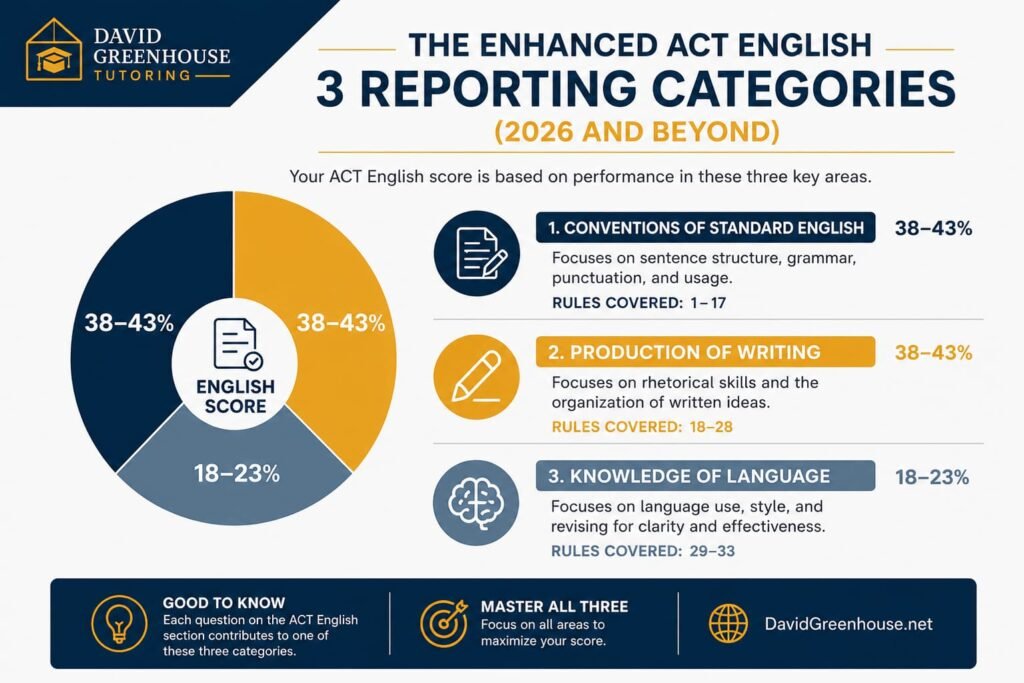
Before the rules, the map. The Enhanced ACT English section gives you 50 questions in 35 minutes — 40 scored, 10 unscored field-test items. Every question now includes a clear question stem, so you always know what is being asked. The questions fall into three reporting categories:
| Category | Share of Test | What It Tests |
|---|---|---|
| Conventions of Standard English | 38–43% | Punctuation, grammar and usage, sentence structure |
| Production of Writing | 38–43% | Organization, transitions, purpose, adding/deleting sentences |
| Knowledge of Language | 18–23% | Concision, word choice, style, and tone |
Notice the balance. Pure grammar is only about two-fifths of the section. The rest tests whether you can think like an editor — a distinction that matters when you decide how to divide your study time. The rules below are organized into those same three categories.
(For strategy and pacing rather than rules, see our guides to scoring 30+ on ACT English and scoring a perfect 36.)
Part 1: Punctuation Rules (the Highest-Error Category)
Punctuation questions cost students more points than any other question type not because the rules are hard, but because students punctuate by instinct instead of by rule. The ACT exploits that instinct relentlessly.
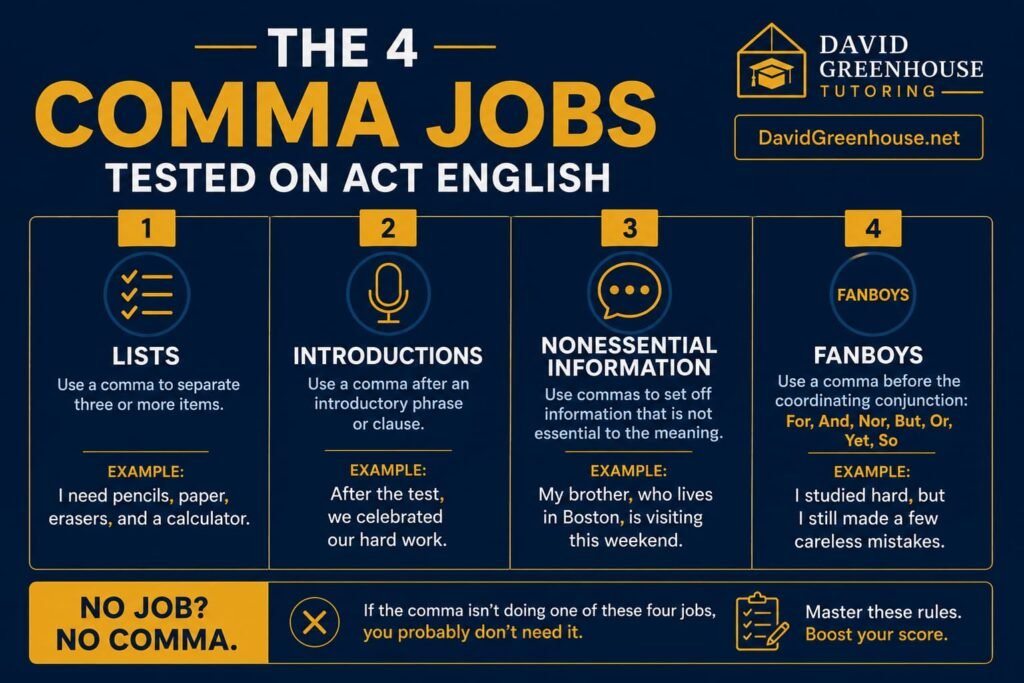
Rule 1: A Comma Has Exactly Four Jobs
If a comma is not doing one of these four jobs, it does not belong in the sentence:
| Comma Job | Example |
|---|---|
| 1. Separating items in a list of three or more | She packed a pencil, a calculator, and her admission ticket. |
| 2. After an introductory word, phrase, or clause | After the first practice test, his score jumped four points. |
| 3. Around nonessential information | Mrs. Alvarez, my junior-year English teacher, drilled this rule daily. |
| 4. Before a FANBOYS conjunction joining two complete sentences | The passage was short, but the questions were demanding. |
The ACT’s favorite trap is the unnecessary comma one wedged between a subject and its verb, or dropped before a preposition. When you cannot name the job a comma is doing, remove it. Fewer commas is usually right.
Rule 2: The Nonessential-Information Test
If you can lift a phrase out of the sentence and the sentence still works, that phrase takes a comma on both sides never just one. My oldest student, who retook the test three times finally hit a 34 fails the test (the closing comma is missing); My oldest student, who retook the test three times, finally hit a 34 passes. One-comma answers around nonessential phrases are wrong every time.
Rule 3: The Semicolon = Period Test
A semicolon joins two complete, independent sentences. The test is mechanical: swap the semicolon for a period. If both halves stand alone as full sentences, the semicolon is correct. If either half cannot stand alone, the semicolon is wrong. There are no exceptions on the ACT.
Correct: The essay is optional; the English section is not. Incorrect: The essay is optional; unlike the English section. (The second half is a fragment.)
Rule 4: A Colon Needs a Complete Sentence Before It
Whatever comes before a colon must be able to stand alone. What comes after can be a list, a phrase, or another full sentence the ACT does not care. It only checks the left side.
Correct: Three rules decide most punctuation questions: the comma jobs, the semicolon test, and this one. Incorrect: Three rules such as: commas, semicolons, and colons. (The left side is a fragment.)
Rule 5: Dashes Work in Pairs or as Colons
A pair of dashes sets off nonessential information, exactly like a pair of commas. A single dash introduces or emphasizes, like a colon. The trap: mixing markers. If a nonessential phrase opens with a dash, it must close with a dash never a comma.
Rule 6: Apostrophes — Possession and Contraction Only
- It’s = it is. Its = possession. (The ACT tests this pair on nearly every form.)
- Singular possession: the student’s error log (one student)
- Plural possession: the students’ error logs (many students)
- Plain plurals never take an apostrophe: tests, not test’s
Part 2: Grammar and Usage Rules
Rule 7: Subjects and Verbs Must Agree
Singular subject, singular verb; plural subject, plural verb. Effortless — until the ACT wedges a prepositional phrase between them. In “The collection of essays, poems, and letters was published,” the subject is collection, not letters. Cross out everything between the subject and the verb, then check agreement. That single habit neutralizes the entire question type.
Rule 8: Verb Tense Must Stay Consistent
The passage sets the timeline; your answer must respect it. If the surrounding sentences are in past tense, the underlined verb almost certainly belongs in past tense. Shifts are only correct when the meaning demands one — a flashback, a general truth, a prediction. When two answer choices differ only in tense, read the sentence before the underlined portion. The passage always tells you.
Rule 9: Pronouns Must Agree — and Must Be Clear
- Agreement: A singular noun takes a singular pronoun. Each student must bring his or her ticket — not their, on the ACT.
- Clarity: A pronoun with two possible antecedents is wrong, no matter how natural it sounds. When Maria met her tutor, she was nervous — who was nervous? The ACT rewards the answer that names the noun.
- Case: Who acts (subject); whom receives (object). The shortcut: if you would answer with he, use who; if with him, use whom.
Rule 10: Modifiers Must Sit Next to What They Describe
A modifying phrase describes the nearest noun — whether you meant it to or not. “Walking into the exam room, the test felt easier” claims the test was walking. The opening phrase must be followed immediately by its true subject: “Walking into the exam room, she felt the test was easier.” On ACT questions, when a sentence opens with a descriptive phrase, check the very next noun. That check answers the question.
Part 3: Sentence Structure Rules
Rule 11: Recognize a Complete Sentence
A complete sentence needs a subject, a conjugated verb, and a complete thought. Missing any one of the three, and you have a fragment. The ACT disguises fragments with length: “The students in the library who studied every Saturday morning throughout the fall semester” is long, detailed — and not a sentence. Length is not completeness.
Rule 12: Fix Run-Ons and Comma Splices
Two complete sentences cannot be joined by a comma alone — that is a comma splice, and the ACT tests it constantly. You have exactly four legal repairs:
- A period: The section is fast. Pacing decides everything.
- A semicolon: The section is fast; pacing decides everything.
- A comma plus a FANBOYS conjunction: The section is fast, so pacing decides everything.
- Subordination: Because the section is fast, pacing decides everything.
Every run-on answer set contains at least one of these four repairs. Find it.
Rule 13: Keep Lists and Comparisons Parallel
Items in a list or comparison must share the same grammatical form. “She improved by drilling commas, reviewing her error log, and timed practice“ breaks the pattern; “…and timing her practice“ restores it. Read list items in isolation. The one that sounds different is different.
Part 4: Knowledge of Language — the Style Rules
Rule 14: The Shortest Correct Answer Usually Wins
The ACT rewards concision. When several answers are all grammatically correct, the shortest one that preserves the meaning is almost always right. “Due to the fact that” loses to “because” every single time.
Rule 15: Kill Redundancy on Sight
“Annually each year,” “completely finished,” “past history,” “final outcome” — if two words do the same job, one of them is wrong. Redundancy questions are free points for students who have learned to hear the echo.
Rule 16: Match the Passage’s Tone
A conversational passage does not suddenly need “utilize”; an academic one does not need “a whole bunch of.” The correct word choice matches the register of everything around it. When in doubt, pick the plain, precise option.
Part 5: Production of Writing — the Editor Rules
Rule 17: Transitions Must Match the Logic
However signals contrast. Therefore signals consequence. For example signals illustration. The ACT tests whether you read the sentence before and after the transition — never guess a transition from the sentence it sits in. If the two sentences agree, a contrast word is wrong, no matter how sophisticated it sounds.
Rule 18: Add or Delete Based on Purpose, Not Interest
“Should the writer add this sentence?” has nothing to do with whether the sentence is interesting. It is a yes only if the sentence supports the specific purpose of that specific paragraph. Identify the paragraph’s job first; then judge the sentence against it.
Rule 19: Placement Questions Are Chronology Questions
When the ACT asks where a sentence belongs, look for its logical anchors — a pronoun that needs an antecedent, a “this” that needs a referent, a step that must follow another step. The sentence locks into exactly one position.
Rule 20: Trust “NO CHANGE”
Not a grammar rule — a scoring rule. “NO CHANGE” is correct more than a quarter of the time it appears. If you cannot name the specific rule the original sentence breaks, it does not break one. Leave it alone.
What the Enhanced ACT No Longer Tests
This is where outdated prep actively hurts students. If your prep book or tutor still drills these, you are studying for a test that retired:
| Retired Concept | Status on the Enhanced ACT (2026) |
|---|---|
| Idiomatic expressions (opposed to, participate in) | No longer explicitly tested |
| 75-question format strategies | Obsolete — the section is now 50 questions in 35 minutes |
| Questions without stems (“underline only”) | Every question now includes a clear question stem |
ACT, Inc. states directly that the Conventions of Standard English category now assesses grammar “without relying on familiarity with idiomatic expressions.” Hours spent memorizing preposition pairings are hours wasted. Spend them on commas.
Know the Rules, but Still Losing Points?
David works one-on-one with NJ students to find the exact rules they keep breaking under time pressure — and drills them with official ACT material until the fix holds on test day. In-person in Hackettstown or virtual anywhere in New Jersey.
Book a Free 15-Minute CallNo group classes · No rotating tutors · Every session is with David
How to Actually Learn These Rules (Not Just Read Them)
Reading a rules list feels productive. It is not the same as owning the rules. After two decades of teaching this material, David uses the same sequence with every student:
- Take one timed section first. You cannot prioritize twenty rules at once. Your wrong answers will point to the four or five that are costing you points.
- Build an error log. For every miss, record the rule involved and why you missed it — didn’t know it, rushed it, or talked yourself out of it. After two sections, your pattern is undeniable.
- Drill one rule family at a time. A week of nothing but comma questions beats a month of mixed review. Isolation builds the reflex; mixed practice then confirms it.
- Use only official ACT material. Third-party questions teach the rule; only official questions teach the phrasing and the traps. The Official ACT Prep Guide 2025–2026 and the free test on ACT.org are built for the Enhanced format.
- Re-test in ten days. A rule is learned when you apply it correctly under time pressure — not when you can recite it.
What This Means for New Jersey Students
New Jersey students face a specific version of this problem. Most NJ high schools teach literature and composition — genuinely valuable — but almost none teach test grammar as a subject. Students at Hackettstown High, West Morris Central, and Mount Olive walk into the ACT having written dozens of essays yet never having been taught the semicolon = period test. The knowledge gap is not their fault; it is a curriculum gap.
It also creates an opportunity. Because these twenty rules are finite and learnable, English is the fastest section on the ACT to improve — typically faster than Math, and dramatically faster than Reading. For students across Warren County — Hackettstown, Allamuchy, Great Meadows, Belvidere, Oxford — and for families in Mendham, Chester, Long Valley, Clinton, and Mount Olive, a focused summer of rule work is often the difference between a 27 and a 32 by the September or October test date.
If you are still deciding when to begin, our ACT prep timeline for NJ students lays out the calendar. If you are deciding between tests entirely, start with SAT vs. ACT in New Jersey.
Where a Tutor Changes the Timeline
Every rule on this page can be self-taught. What a student cannot easily do alone is see which rules they are breaking and why they keep breaking them under time pressure. That diagnosis is the work David does with ACT English students across Hackettstown and Northern New Jersey: read twenty wrong answers, name the two patterns behind them, and drill those patterns with official material until the reflex holds on test day. One-on-one, never a generic curriculum.
Turn This Rules List Into a Real Score Jump
One diagnostic session is enough to identify which of these 20 rules are costing your child points — and how many weeks it takes to fix them before the September or October ACT.
Book a Free 15-Minute CallNo group classes · No rotating tutors · Every session is with David
Frequently Asked Questions
How many grammar rules are on the ACT English test? The Enhanced ACT draws on roughly 20 recurring rules across punctuation, grammar and usage, sentence structure, style, and organization. The full list is finite and learnable — the test repeats the same concepts on every form.
What is the most tested grammar rule on ACT English? Comma usage is the most frequently tested concept, followed by sentence-structure errors (run-ons, comma splices, and fragments) and subject–verb agreement.
Are idioms still tested on the ACT in 2026? No. The Enhanced ACT no longer explicitly tests idiomatic expressions. Prep guides that still teach preposition idioms are describing the old test.
How is ACT English different on the Enhanced ACT? The section dropped from 75 questions in 45 minutes to 50 questions in 35 minutes (40 scored, 10 unscored field-test items), every question now includes a clear question stem, and idiom testing was removed.
What is the semicolon rule on the ACT? A semicolon must join two complete, independent sentences. Test it by swapping in a period: if both halves stand alone, the semicolon is correct.
What are the FANBOYS conjunctions? For, and, nor, but, or, yet, so. A comma plus a FANBOYS conjunction is one of the four legal ways to join two complete sentences.
Is “NO CHANGE” usually right on ACT English? It is correct more than 25% of the time it appears. If you cannot name a specific rule the original sentence breaks, choose NO CHANGE.
What percentage of ACT English is grammar? Conventions of Standard English (punctuation, grammar, sentence structure) makes up 38–43% of the section. The remainder tests organization, style, and editorial judgment.
How long does it take to learn all the ACT grammar rules? Most students can master the core rules in four to eight weeks of focused practice with an error log. Students working one-on-one with a tutor typically compress that timeline because weaknesses are diagnosed in the first session.
Where can I get help with ACT English grammar in New Jersey? David Greenhouse offers one-on-one ACT English tutoring in person across Warren County and virtually throughout New Jersey, specializing exclusively in the English, Reading, and Writing sections.
David Greenhouse Tutoring
DG — About the Author — David Greenhouse Private English & Test-Prep Tutor · Hackettstown, NJ · 20+ Years’ Experience
David Greenhouse has spent over two decades coaching students across Warren and Morris County through the ACT and SAT. He has worked with more than 4,000 students, privately tutored over 275 one-on-one, and guided 75+ families through the full college application process. His students have gone on to Cornell, the University of Pennsylvania, Rutgers, Lehigh, Villanova, and Penn State. He specializes exclusively in the ACT English, Reading, and Writing sections — the areas where targeted preparation moves scores the most.
