
Quick Answer
To score a 36 on ACT English, you can miss 0 questions on most Enhanced ACT forms (1 wrong usually means a 35). You need near-perfect command of three skill areas — punctuation, grammar/usage, and rhetorical skills — plus the pacing to finish 50 questions in 35 minutes with time to review. The fastest path: master the rules the ACT repeats on every test, trust “NO CHANGE,” and pick the most concise correct answer. Most students scoring 30+ reach 36 in 6–12 focused weeks.
A 36 Is Not About Knowing More English. It’s About Missing Less.
Here’s the thing most students get wrong before they even start: they assume a perfect ACT English score requires some elite, secret level of grammar knowledge. It doesn’t. The English section does not test obscure rules. It tests the same handful of rules over and over, and it tests whether you can apply them quickly without second-guessing yourself.
David Greenhouse has spent over 20 years coaching students across Warren, Morris, and Hunterdon County through exactly this section, and the pattern is always the same. Students scoring in the high 20s or low 30s almost never have a knowledge problem. They have a consistency problem. They know the comma rule, but they talk themselves out of it on question 34 because they’re tired and rushing. A 36 is what happens when you close that gap.
So this guide is not a grammar lecture. It’s a strategy for missing zero.
What “36” Actually Requires on the Enhanced ACT
The ACT changed in 2025, and a lot of guides online still describe the old test. Here’s the current reality.
| Feature | Enhanced ACT English (2025–2026) |
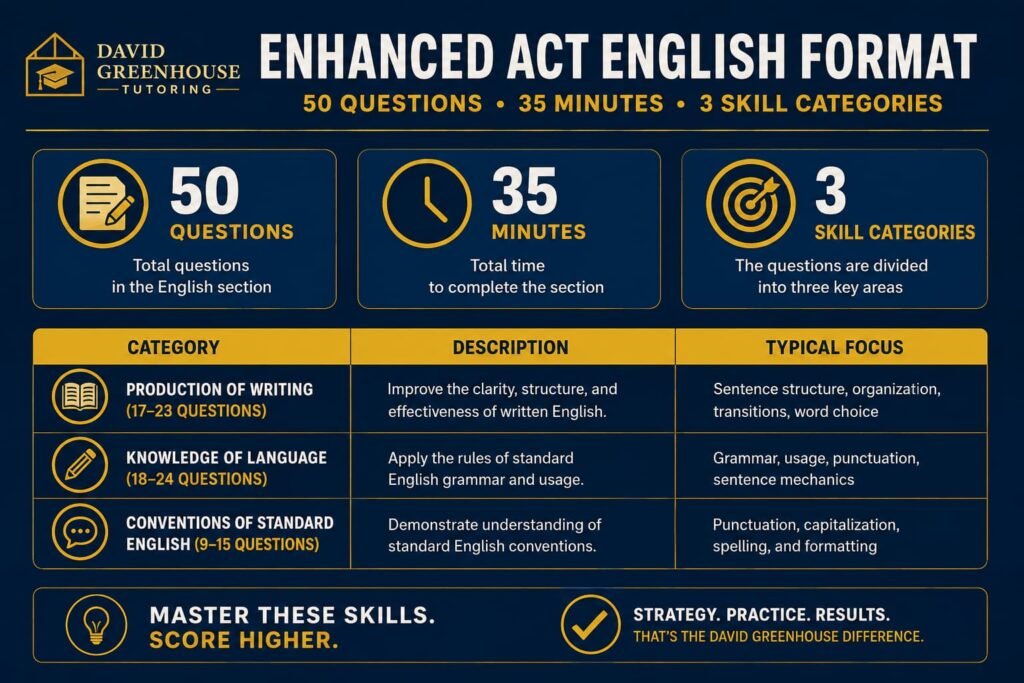
| Questions | 50 (40 scored, 10 unscored field-test items) |
| Time | 35 minutes |
| Time per question | ~42 seconds |
| Passages | Shorter prose passages; you act as the editor |
| Scoring | 1–36 scale |
| Wrong answers for a 36 | Usually 0 (1 wrong typically = 35) |
| Composite weight | One-third (Science is now optional) |
That last row matters more than people realize. Because Science no longer counts toward the composite by default, English now carries a full third of your score. A 36 here pulls real weight.
The three skill categories tested:
- Production of Writing (≈38–43%): organization, transitions, whether a sentence belongs, choosing the best intro or conclusion.
- Conventions of Standard English (≈38–43%): grammar, punctuation, sentence structure.
- Knowledge of Language (≈18–23%): word choice, concision, tone, killing redundancy.
Notice that grammar and “writing quality” judgment are weighted almost equally. You cannot reach a 36 by only being a grammar machine. You also have to think like an editor.
Step One: Find Out Why You’re Missing Questions
Before you study anything, take one full, timed English section from an official source and do something most students skip: build an error log.
For every question you missed — and every one you guessed right — write down:
- The question type (comma, transition, verb tense, concision, etc.)
- Why you missed it (didn’t know the rule, knew it but rushed, misread the question, fell for a trap)
After one or two sections, your weaknesses stop being a mystery. Almost every student falls into one of two camps:
- Content gaps: You genuinely don’t know a rule. (Fixable fast — there aren’t many rules.)
- Timing/confidence gaps: You know the rules but lose points under pressure. (This is most high-scorers, and it’s a strategy problem, not a knowledge problem.)
You cannot fix what you haven’t diagnosed. This single habit is the difference between studying hard and studying smart. If you’re not yet consistently in the high 20s, start with the foundational work in our guide on ACT English strategies to score 30, then come back to this one.
Step Two: Master the Rules the ACT Actually Repeats
The ACT recycles a short list of concepts on every single test. Lock these down and you’ve handled the majority of the section.
Punctuation (the highest-error-rate category)
- Commas: The ACT loves to add commas that don’t belong. When in doubt, fewer commas is usually right. Know the four real comma jobs (lists, after intro phrases, around non-essential information, before a FANBOYS conjunction joining two complete sentences) and reject every other comma.
- The semicolon = period test: A semicolon must join two complete, independent sentences. If you can swap in a period and both halves still stand alone, the semicolon is correct.
- Apostrophes: Its vs. it’s, plural vs. possessive. Quick to learn, frequently tested.
- Colons and dashes: A colon needs a complete sentence before it. Dashes can act like commas or colons depending on context.
Grammar and Usage
- Subject-verb agreement (watch for words wedged between the subject and verb)
- Pronoun clarity and case (who vs. whom, its vs. their)
- Verb tense consistency within the passage
- Modifier placement — make sure the describing phrase sits next to what it describes
Sentence Structure
- Run-ons, comma splices, and fragments
- Parallel structure in lists and comparisons
Rhetorical Skills (Production of Writing + Knowledge of Language)
This is where strong students gain their last few points. Three habits:
- Shortest correct answer usually wins. The ACT rewards concision. If two answers are both grammatically correct, the briefer one is almost always intended.
- Transitions must match logic. Don’t pick “however” if the sentence agrees with the one before it. Read the sentence before and after.
- Stay on topic and in tone. “Add/delete this sentence” questions hinge on whether the sentence supports the paragraph’s actual purpose — not whether it’s interesting.
Step Three: Trust “NO CHANGE”
This is the tip that separates a 34 from a 36. “NO CHANGE” is correct more than a quarter of the time it appears. Students lose easy points because they assume every question must contain an error and “fix” something that was already right.
The mindset shift: your job is not to find an error. Your job is to choose the best version — and sometimes the original is the best version. If you can’t name a specific rule the original breaks, leave it alone.
Ready to Turn a 33 Into a 36?
David works one-on-one with NJ students on the exact ACT English question types costing them points — using only official materials, built around your actual test. In-person in Hackettstown or virtual anywhere in New Jersey.
Book a Free 15-Minute CallNo group classes · No rotating tutors · Every session is with David
Step Four: Beat the Clock (Pacing for 36)
With ~42 seconds per question, pacing on the Enhanced ACT is slightly more forgiving than the old test — but a 36 still demands a rhythm. David addresses timing in the first session for a reason: timing problems sabotage students who actually know the material.
- Answer in order, don’t linger. Most questions take far less than 42 seconds. Bank that time.
- The two-pass method: If a question takes more than ~30 seconds, mark it, pick your best guess, and move on. Return with leftover time.
- Aim to finish with 3–5 minutes left. A 36 requires a review pass — you’ll catch one or two careless errors every time, and on this test one error is the whole game.
- Never leave a blank. No guessing penalty. Every bubble gets filled.
Step Five: Practice With Real Tests, Not Imitations
Third-party questions can teach a rule, but only official ACT materials replicate the exact phrasing, trap patterns, and rhythm of the real test. Students who’ve drilled real material walk in recognizing the test instead of adjusting to it.
The official source for current-format practice is the Official ACT Prep Guide 2025–2026, which includes practice tests built for the Enhanced format, plus the free digital practice test on the ACT’s official website. Older tests still work for the grammar itself — just simulate the new format by doing the first 50 questions in 35 minutes.
Scoring 36 on ACT English in New Jersey: What Local Students Should Know
A perfect English score carries extra weight for New Jersey students, and not for the reason most families assume. Across Warren, Morris, and Hunterdon County, plenty of strong students get overlooked simply because their high school doesn’t carry the name recognition of a wealthier district. A 36 on ACT English is one of the few things on an application that can’t be argued with — it puts a Hackettstown student’s file on the same desk as students from districts with twice the budget.
A few NJ-specific realities worth knowing:
- Most NJ families default to the SAT. That’s habit, not strategy. Some students who plateau on the digital SAT improve immediately on the ACT because the pacing fits how they think. If you haven’t decided yet, our breakdown of SAT vs. ACT in New Jersey and the digital SAT vs. paper ACT comparison are the right starting points.
- Junior year in NJ is packed. Between coursework, sports, and activities at schools like Hackettstown High, the students who hit a 36 are the ones who start early and prep efficiently rather than cramming.
- Local specialist access is thin. Most premium test-prep tutors set up in Morris County. Warren County families across Hackettstown, Allamuchy, Great Meadows, Belvidere, and Oxford often face a 30-minute drive or a generic learning center. Working with a dedicated ACT English tutor in Hackettstown closes that gap.
David works with students in person across Warren County and virtually throughout New Jersey, including families in Mendham, Chester, Long Valley, Clinton, and Mount Olive. If you want the full picture of how local prep works, see our SAT & ACT tutoring guide for Hackettstown, NJ.
A Realistic 36 Timeline
| Starting Score | Typical Effort to Reach 36 |
| 33–34 | Fine-tuning: error log + concision/transition drills, often 3–5 weeks |
| 30–32 | Targeted rule cleanup + pacing work, ~6–10 weeks |
| 26–29 | Build the rule foundation first, then push for perfection |
| Below 26 | Reach the high 20s first before chasing 36 |
These ranges assume consistent weekly practice and a working error log. A good tutor compresses every one of these timelines by diagnosing faster and killing recurring mistakes before they become habits.
Where a Tutor Actually Moves the Needle
You can reach a 36 on your own — plenty of disciplined students do. But the students who get there fastest usually have someone who can look at twenty of their wrong answers and immediately name the pattern they can’t see themselves.
That’s the work David does with ACT English students across Hackettstown and Northern NJ: diagnose the exact question types costing points, drill those specifically with official material, and build the pacing and review habits that turn a 33 into a 36. Sessions are one-on-one, built around your actual test, never a generic curriculum.
Ready to Turn a 33 Into a 36?
David works one-on-one with NJ students on the exact ACT English question types costing them points — using only official materials, built around your actual test. In-person in Hackettstown or virtual anywhere in New Jersey.
Book a Free 15-Minute CallNo group classes · No rotating tutors · Every session is with David
Frequently Asked Questions
Can you miss any questions and still get a 36 on ACT English? On most Enhanced ACT forms you must miss 0 questions for a 36; missing 1 usually gives you a 35.
How many questions is the ACT English section now? 50 questions in 35 minutes — 40 are scored and 10 are unscored field-test items.
Is a 34 basically as good as a 36 for college? For nearly every college, yes — a 34 already clears most score thresholds, so the rest of your application matters more.
How long does it take to reach a 36 on ACT English? Most students scoring 30+ need roughly 6–12 weeks of focused practice with an error log.
Is “NO CHANGE” really a common correct answer? Yes — it’s correct more than 25% of the time it appears, so don’t assume every question hides an error.
Do I need to memorize grammar rules to score 36? No — you need to master a small, repeated set of rules and apply them quickly under time pressure.
Does ACT English still matter now that Science is optional? More than before — English now counts for a full third of your composite score.
What’s the single biggest mistake high-scorers make? Over-correcting: changing answers that were already right instead of trusting the original wording.
Where can I find an ACT English tutor for a 36 in New Jersey? David Greenhouse offers one-on-one ACT English tutoring in person across Warren County and virtually throughout NJ, specializing only in English, Reading, and Writing.
Do New Jersey students take the SAT or ACT more often? Most NJ students default to the SAT, but the ACT is often the better fit for students who work quickly and plateau on the digital SAT.
About the Author — David Greenhouse
Private English & Test-Prep Tutor · Hackettstown, NJ · 20+ Years’ Experience
David Greenhouse has spent over two decades coaching students across Warren and Morris County through the ACT and SAT. He has worked with more than 4,000 students, privately tutored over 275 one-on-one, and guided 75+ families through the full college application process. His students have gone on to Cornell, the University of Pennsylvania, Rutgers, Lehigh, Villanova, and Penn State. He specializes exclusively in the ACT English, Reading, and Writing sections — the areas where targeted preparation moves scores the most.
