
What Are the Best ACT English Strategies for 2026?
The best ACT English strategies are: learn the top grammar rules, read each passage fully before answering, pace to about 42 seconds per question (35 minutes for 50 questions), treat “NO CHANGE” as a real answer, and focus on conciseness for rhetoric questions. Students who follow these steps consistently score 30 or higher.
What Is the ACT English Section, Really?
A lot of students hear “English test” and think it is just about writing essays or knowing fancy vocabulary. That is not what this test is at all.
The ACT English section gives you gives you 4 to 6 passages… You have 35 minutes to answer 50 questions (40 scored, 10 unscored), about 42 seconds per question. Every question now includes a clear stem, and idioms are no longer tested, which sounds fast but is very manageable once you know what to look for.
The test covers two big skill areas:
- Conventions of Standard English — this is grammar, punctuation, and sentence structure
- Production of Writing — this is rhetoric, meaning how ideas are organized, how writing flows, and whether sentences are clear and useful
Think of it this way: grammar questions ask, “Is this correct?” Rhetorical questions ask, “Is this good writing?”
For parents reading this
If your child has strong English grades but a middling ACT score, that gap is not a knowledge problem. It is a test-reading problem, and it is one of the most coachable parts of the whole exam.
I work one on one with New Jersey students on exactly this. Twenty years, 4,000+ students, every session taught by me.
Book a Free 15-Minute CallOr call (973) 255-7331. David replies personally.
ACT English Test Format: What You Need to Know Before You Study
Before you learn strategies, you need to understand the battlefield. Here is the full breakdown of the ACT English test format.
The Passages (4–6)
Each of the five passages is a short essay about a real topic — history, science, culture, or personal stories. They are about 300–500 words each. You answer roughly 8–12 questions per passage.
Some questions point to an underlined part of a sentence. Others ask about a full paragraph or the whole essay.
The Two Categories of Questions
Category 1: Conventions of Standard English (Grammar)
These make up roughly 40% of the Enhanced ACT English section. They check whether you know the rules of correct English writing.
The main grammar topics tested are:
| Grammar Topic | Approx. Frequency |
| Punctuation (commas, apostrophes, colons) | Very High |
| Subject-Verb Agreement | High |
| Pronoun Agreement | High |
| Sentence Structure (run-ons, fragments) | High |
| Parallelism | Medium |
| Verb Tense | Medium |
| Modifiers | Medium |
Category 2: Production of Writing (Rhetoric)
On the Enhanced ACT these carry more weight than grammar, about 60% combined (Production of Writing plus Knowledge of Language). They check whether the writing is clear, organized, and purposeful. This is a real shift from the old test, where grammar dominated, so rhetoric now deserves more of your prep time.
The main rhetoric topics are:
| Rhetoric Topic | Approx. Frequency |
| Relevance (add or delete sentences?) | Very High |
| Transitions (connecting ideas) | High |
| Concise (cutting wordy phrases) | High |
| Purpose (does this sentence achieve the goal?) | Medium |
| Order and Organization | Medium |
The Top ACT English Grammar Rules You Must Know
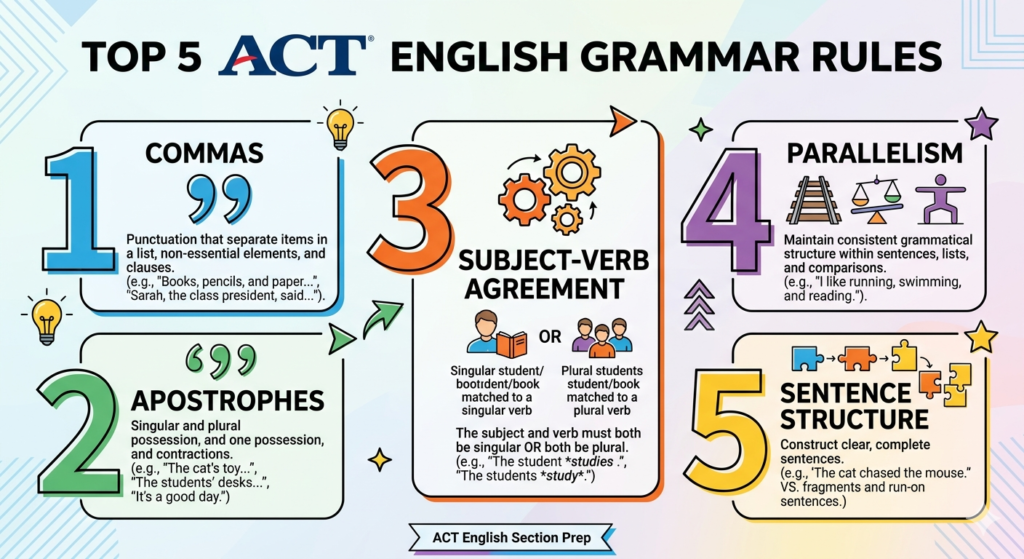
Here is something that will save you a lot of time: about 70% of all grammar questions come from just 10 rules. You do not need to memorize a giant grammar textbook. You need to know these rules cold.
Commas — The #1 Tested Punctuation Rule
Commas are tested more than any other punctuation mark. The key things to know:
- Use a comma before a coordinating conjunction (for, and, nor, but, or, yet, so) when joining two full sentences.
- Use commas around extra information that can be removed without changing the sentence’s meaning.
- Do NOT use a comma just because a sentence feels long.
Quick trick: If you can remove the phrase between the commas and the sentence still makes sense, the commas are probably correct.
Apostrophes — Easy Points If You Know the Rule
Apostrophes only do two things: show possession or show a contraction (a shortened word).
- Its = belonging to it (no apostrophe)
- It’s = it is (apostrophe = contraction)
- They’re = they are
- Their = belonging to them
When in doubt, read the sentence out loud with the full words. “It is going to rain” makes sense. “It is collar” does not.
Subject-Verb Agreement
The subject and the verb must match. Singular subjects need singular verbs. Plural subjects need plural verbs.
The tricky part: the ACT loves to put extra words between the subject and the verb to confuse you.
Example: The box of old letters was found in the attic.
“Box” is the subject, not “letters.” So the verb is “was” (singular), not “were.”
Parallelism — A Surprisingly Common Topic
When a sentence lists things, all the items must match in form.
Wrong: She likes hiking, swimming, and to run.. Right: She likes hiking, swimming, and running.
Sentence Structure — No Run-Ons, No Fragments
A run-on sentence tries to be two sentences at once without the right connector. A fragment is an incomplete thought.
The ACTs this by putting two full ideas together with just a comma. That is called a comma splice, and it is always wrong.
Fix it with: a period, a semicolon, or a conjunction like “and” or “but.”
ACT Rhetorical Skills: How to Answer the “Soft” Questions
Many students ignore rhetoric because it feels harder to study. Big mistake. Rhetoric questions make up nearly half the test, and once you learn the patterns, they are very predictable.
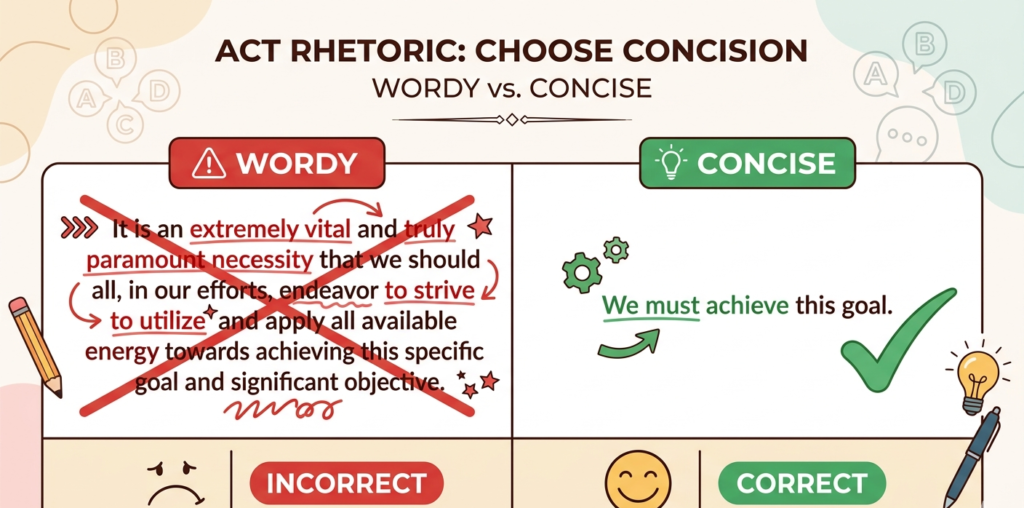
The Concise Rule — The Most Useful Rhetoric Strategy
The ACT almost always rewards shorter, cleaner answers. If two answer choices say the same thing but one uses fewer words, pick the shorter one.
The test regularly gives you options like:
- “due to the fact that” vs. “because.”
- “at this point in time” vs. “now.”
- “in spite of the fact that” vs. “although.”
The shorter answer is almost always correct.
Relevance Questions — Add or Delete?
These questions ask: “Should this sentence be added or removed?”
Here is the simple rule: if the sentence directly supports the main idea of the paragraph, add it. If it goes off-topic, even slightly, remove it.
The ACT will often try to trick you with a sentence that sounds interesting but does not fit the paragraph’s purpose. Stay focused on what the paragraph is actually about.
Transition Questions — Connecting Ideas the Right Way
Transition words like “however,” “therefore,” “for example,” and “in addition” each mean something specific.
- Use “however” or “although” when the ideas contrast.
- Use “therefore” or “as a result” when one idea causes another.
- Use “for example” or “specifically” when giving an example.
Read the sentence before and after the blank. Figure out the relationship between the ideas, then pick the transition that matches.
Purpose and Order Questions
Some questions ask things like: “Which sentence best introduces this paragraph?” or “Where should the following sentence be added?”
For these, always read the whole paragraph first. Then ask yourself: what is this paragraph trying to do? The correct answer will fit the purpose of the paragraph, not just sound nice.
ACT English Time Management: The 42-Second-Per-Question Pace.
Time management on ACT English is not about reading faster. It is about knowing your moves before you make them.
Here is the system that works:
The Passage-Based Pacing System
You have 5 passages and 45 minutes. That means you get 9 minutes per passage. That is your target. Not 8 minutes. Not 11 minutes. Nine.
After you finish each passage, do a quick mental check: “Am I ahead, on time, or behind?”
- Finished in 7 minutes? You have 2 minutes in the bank.
- Finished in 10 minutes? You are behind. Speed up on the next one.
How Long to Spend Per Question Type
Not all questions need the same amount of time. Here is the breakdown:
| Question Type | Target Time |
| Simple grammar (punctuation, apostrophe) | 15–25 seconds |
| Complex grammar (agreement, parallelism) | 25–40 seconds |
| Rhetoric (relevance, transitions) | 40–60 seconds |
| Big picture (whole passage or paragraph) | 45–60 seconds |
Read the Full Sentence, Not Just the Underline
This is one of the most common mistakes students make. They only read the underlined portion and guess. That almost always leads to the wrong answer on rhetoric questions.
You need context. Read the full sentence. For rhetorical questions, read the sentence before and after, too. The right answer fits the whole paragraph, not just the underlined part.
The “NO CHANGE” Strategy
Every grammar question has “NO CHANGE” as one of the answer choices. Many students skip it because it feels like giving up. Do not do that.
About 20–25% of answers are NO CHANGE. The passage is often already correct. If you read the sentence and nothing feels wrong, trust your instincts and pick NO CHANGE.

How to Score 30+ on ACT English: A Step-by-Step Plan
Getting a 30 on ACT English means getting about a full 35-minute practice section roughly 83%. That is a very achievable goal with focused preparation.
Here is the exact plan:
Step 1: Take a Timed Diagnostic First
Do not start studying random topics. Take one real ACT English practice section under full-time conditions first. This shows you exactly where your points are leaking.
After the practice test, sort your mistakes into buckets:
- Was it a grammar rule I did not know?
- Was it a rhetorical question I misread?
- Was it a time problem?
Step 2: Learn Grammar Rules in Order of Frequency
Start with the most-tested rules: commas, apostrophes, and subject-verb agreement. Then move to parallelism, verb tense, modifiers, and pronouns. Learn one rule at a time and do 10–15 practice questions on just that rule before moving on.
Step 3: Practice Rhetoric With Real Passages
Rhetoric is harder to drill in isolation. The best way to improve is to do full passages and review why the correct rhetorical answer is right. Pay attention to the paragraph’s main idea every single time.
Step 4: Do Timed Passage Sets Weekly
Once a week, do a full 45-minute practice section. Track your score. Track which rule categories you are still missing. Adjust your study focus accordingly.
Step 5: Review Every Wrong Answer
This step is where most students skip out — and it is the most important step. Every wrong answer tells you something. If you got it wrong and still do not understand why, that is a knowledge gap you must close before test day.
Common ACT English Mistakes That Cost You Points
Even prepared students lose points because of these mistakes. Make sure you are not doing any of these.
Mistake #1: Choosing the Longest Answer. Longer answers feel more complete, but the ACT rewards brevity. If one answer is clearly shorter and means the same thing, it is almost always right.Mistake #2: Ignoring the Question Stem. Rhetorical questions give you a specific instruction: “Which choice best supports the paragraph’s main claim?” If you do not read the instructions, you will pick a logically wrong and grammatically fine answer.
Mistake #3: Changing a Correct Answer. Many students talk themselves out of right answers. If your first read of a sentence felt fine, do not change it unless you find a specific rule violation.
Mistake #4: Skipping Passages to Save Time Do not jump around. Go in order. The passages are not arranged by difficulty, and skipping around wastes mental energy.
Mistake #5: Not Practicing Under Time Pressure. Practice without a timer gives you a false sense of confidence. Always simulate real test conditions at least once a week.
ACT Punctuation Strategy: The Fast-Points Section
Punctuation questions are the fastest wins on the entire test. Learn these three rules, and you will get most of them right.
Colons and Semicolons
- A semicolon connects two complete sentences without a conjunction.
- A colon introduces a list, explanation, or quote — but only after a complete sentence.
Dashes
A dash works like a colon but feels more informal. It can set off extra information or introduce an explanation. On the ACT, one dash must be matched with another dash if the information in the middle is removable.
Commas With Lists
In a list of three or more items, the ACT follows the rule of using a comma before the final “and.” Example: She bought apples, oranges, and bananas.
Quick tip: if an answer choice adds a comma that is not needed, it is almost always wrong. The ACT does not like extra commas.
ACT English Tips From a Tutoring Expert
At David Greenhouse Tutoring, we have worked with hundreds of students across Warren County and beyond to raise ACT English scores — sometimes by 6 to 8 points in just a few weeks of focused work. Here is what consistently separates students who score in the 30s from those stuck in the 20s.
The students who score 30+ all share one habit: they review their errors out loud. They do not just check whether they got a question right or wrong. They explain the rule behind each answer, as if they are teaching it to someone else. This forces real understanding instead of surface recognition.
We call this the “teach it back” method, and it works every time. If you cannot explain why “its” is correct instead of “it’s” in a sentence, you do not really know the rule yet.
Work with a private ACT English tutor — Book a free 15-minute consultation with David Greenhouse

Best Resources for ACT English Practice in 2026
You do not need to spend a lot of money to get great ACT English practice. Here is what actually works:
- Official ACT Practice Tests — Always start here. The ACT’s free online resources include real past questions and explanations.
- Targeted Grammar Rule Drills — Find practice sets organized by rule type, not just random mixed practice.
- Timed Full Sections — At least one every week in the month before your test.
- Error Log — A simple notebook or spreadsheet where you track every wrong answer, the rule it tested, and your explanation of why the right answer is correct.
- 1-on-1 Tutoring — For students who want personalized feedback and faster score gains, private tutoring with an experienced ACT coach is the most efficient path.
Ready to Score 30+ on ACT English?
You now have everything you need: the test format, the top grammar rules, the rhetoric strategies, the time management system, and a step-by-step study plan.
The ACT English section rewards preparation more than almost any other section on the test. The rules are finite. The patterns are predictable. The more you practice the right way — with full review after every session — the faster your score will climb.
If you want a faster path to a 30+ score with personalized feedback on your exact weak spots, private tutoring is the most efficient investment you can make.
Book a free consultation with David Greenhouse to talk about your ACT English goals
David has helped 4,000+ students improve their test scores and get into their top-choice colleges. Your next score jump starts with one conversation.

FAQs:
What is the fastest way to improve my ACT English score?
Learn the top grammar rules first (commas, apostrophes, subject-verb agreement), then review every wrong answer from practice tests until you can explain the rule.
How many questions can I miss and still get a 30 on ACT English?
Aim for 9 minutes per passage to finish all 5 passages in 45 minutes.
Should I read the whole passage or just the underlined part?
Always read the full sentence at a minimum. For rhetorical questions, read the full paragraph before answering.
What does “NO CHANGE” mean on ACT English?
It means the underlined portion is already correct. About 20–25% of answers are NO CHANGE, so do not ignore them.
How long should I spend on each ACT English passage?
Aim for 9 minutes per passage to finish all 5 passages in 45 minutes.
