
Quick Answer
Yes, you can submit your Common App before your August ACT scores arrive. Most schools accept applications before official test scores are received. What matters: submit your personal statement before the deadline, self-report your pending test date, and make your essay exceptional since it will be reviewed first. Schools prioritize complete applications after decisions, so strong essay writing compensates when scores are pending.
The Honest Truth: Can You Submit Before ACT Results Arrive?
You took the ACT in August. The deadline is looming September 1 for Early Decision, November 1 for Regular Decision. The testing agency says your scores will arrive in 5-7 business days, but that’s not a guarantee. You’re asking the real question: Do I submit now or risk missing the deadline?
The answer is direct: yes, you can submit your Common App before your ACT scores arrive. Colleges expect this. The admissions system is built for it.
But here’s what most students don’t understand submitting early doesn’t mean your application gets reviewed early. It means your essay gets read while your file is still incomplete. That changes the strategy.
Why Schools Allow It
Every major university accepts applications before all materials arrive. It’s not a loophole; it’s standard practice. Thousands of students submit between test dates. Self-reported scores are sufficient for application review, and official scores can be sent after the deadline.
The Common App Testing section lets you enter a future test date. That’s the safety valve. You’re telling the school: “I’m sitting for the ACT on August 15. Here’s when I expect scores.” Then you hit submit.
The college’s system flags your application as “awaiting official scores.” They don’t reject you. They wait.
When Scores Still Matter (Even if You Submit Early)
Here’s the tension: test-optional doesn’t mean scores don’t help. If you’re applying to competitive NJ schools like Rutgers-New Brunswick, Drew University, or Seton Hall, a strong ACT score in the 75th percentile range can move the needle. But an incomplete application with a stunning essay? That moves the needle harder.
| Application Status | Review Timeline | Score Impact |
|---|---|---|
| Early submission (before Aug 28) | Essay read immediately; flagged for test results | Score reviewed when received; essay already judged |
| Late submission (after Sept 5) | Entire file reviewed together | Score and essay weighted equally |
| Submitted after deadline | Reviewed if space exists; lower priority | Score needed if complete file incomplete |
The table shows the real dynamic: early submission means your essay is judged on its own merits first. Your score arrives later and either confirms what the essay suggested or surprises them. Either way, your essay already did its work.
Timeline Reality: When Scores Actually Arrive vs. When Schools Review
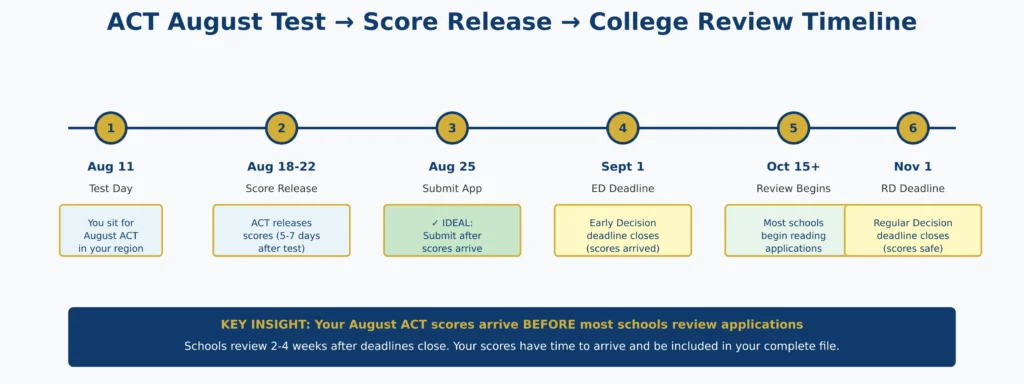
This is where most students panic unnecessarily. The confusion comes from three different timelines colliding: when your scores drop, when application deadlines close, and when colleges actually start reading.
ACT August Test Date → Score Release: If you test on August 11, 2026, ACT publishes scores 5-7 business days later (typically August 18-22). That’s earlier than most students expect. You’re not stuck waiting until Labor Day.
Common App Deadlines (2026-2027 cycle):
- Early Action: November 1, 2026
- Early Decision: November 1, 2026
- Regular Decision: January 1-5, 2027
When Do NJ Colleges Actually Start Reading? This is the secret admissions officers don’t advertise: they don’t review applications the day the deadline closes. Rolling admissions schools (like Rutgers) start in September. Selective schools (like Princeton, Villanova for NJ students) don’t start until mid-October.
📌 Key insight for NJ students: If you test on August 11 and submit your app on August 25, your scores likely arrive (August 18-22) BEFORE schools start reviewing in October. Your file is already complete when they read it.
The anxiety comes from assuming schools review instantly. They don’t. They batch review. And they build in buffer time for late materials.
Should You Submit Your Application Now or Wait?
This decision gets clearer when you ask yourself three questions:
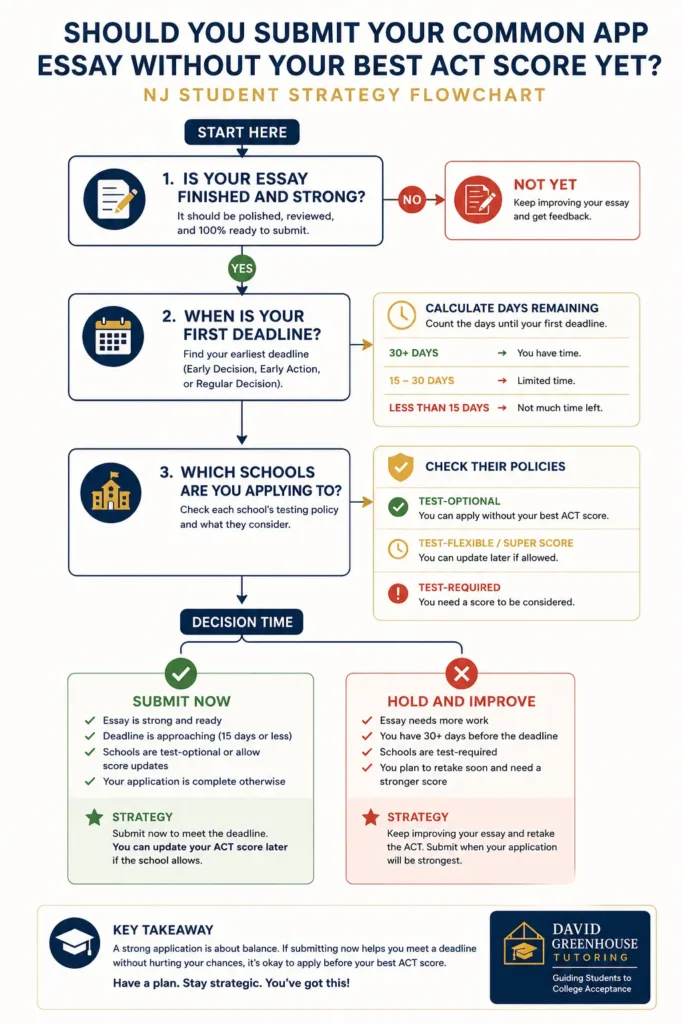
Here’s the framework in plain language:
Submit Your Application Now If:
- Your essay is finished. Not “almost done.” Finished, revised, polished. Your essay is the asset when scores are pending. A rushed essay won’t save you if scores arrive weak.
- You have 30+ days until your earliest deadline. This gives scores time to arrive (5-7 days), official reports time to reach schools (10-14 days), and you breathing room if something goes wrong.
- You’re applying to test-optional schools. Check their actual policy. Many schools allow students to apply without submitting test scores, and at those schools the essay carries relatively more weight in holistic review. If your school is legitimately test-optional, submitting before scores is pure upside.
- Your ACT practice scores are solid. If you consistently scored 32-34 in practice, you know roughly what your official score will be. Submitting early signals confidence.
Wait for Your Scores If:
- Your essay needs significant revision. Don’t submit an incomplete application with an unfinished essay to avoid it sitting in limbo. That’s the wrong reason. Finish the essay first.
- Your test date is after October 1. Now you’re cutting it close. Late October tests mean scores arrive in early November after many EA/ED deadlines. You’re better off waiting for your actual score and submitting a complete package.
How to Position Your Essay When Your ACT Score Isn’t Finalized
Here’s the psychological reality: admissions officers know that thousands of students submit before test scores. They’re not suspicious. They’re expecting it. What they’re reading is your essay with the assumption that your score will be in a predictable range.
Your essay’s job when scores are pending: prove the score will back up what you’ve told them about yourself.
If your essay shows intellectual curiosity, evidence of independent thinking, and clear values—the person described in that essay should have a decent ACT score. The essay creates the expectation. The score confirms it.
What makes a strong essay when scores are pending:
The essay must do work that test scores cannot measure. It must show judgment, voice, reflection, and honesty. If an admissions officer can read your essay and see the person behind the GPA and course list, the essay works whether your ACT score is 30 or 34.
Common mistake students make: They assume a weak ACT score + strong essay = rejection. That’s backwards. A strong essay + a competent score = acceptance at most schools. It’s a weak essay + weak score = problem.
New Jersey Colleges and the August ACT: What You Actually Need to Know
If you’re a New Jersey student, your college options span test-required, test-optional, and flexible policies. Here’s what matters for your specific situation:
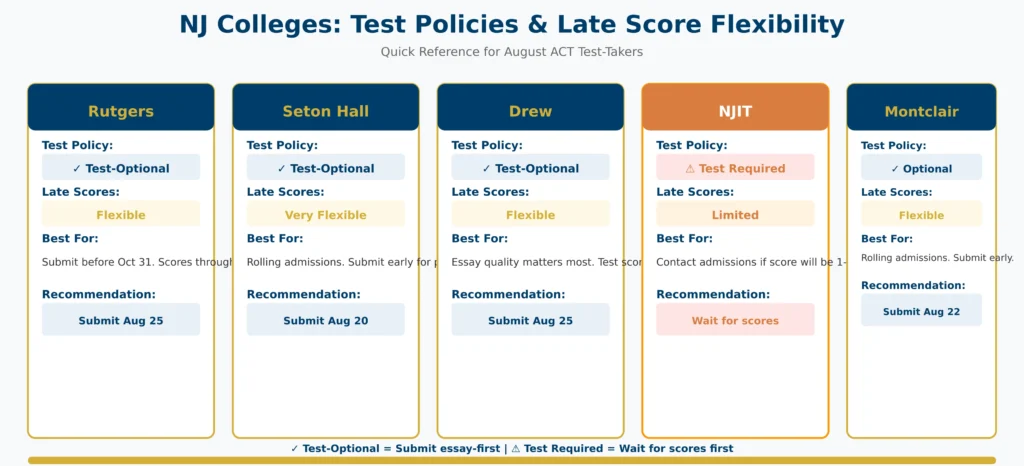
Rutgers University (New Brunswick & other campuses)
- Policy: Test-optional for many programs
- Late scores: Accepted through early November
- Reality: Submit your app by October 31. Scores arriving in early November won’t hurt.
Seton Hall University (South Orange)
- Policy: Test-optional for 2026-27 cycle
- Late scores: Accepted as part of rolling admissions
- Reality: Apply early for rolling admissions advantage. Scores don’t change rolling status.
Drew University (Madison)
- Policy: Test-optional
- Late scores: Part of holistic review; not penalized for timing
- Reality: Essay quality matters more than score timing.
NJIT (Newark)
- Policy: Test required; slightly flexible on timing
- Late scores: Can appeal for late submission consideration
- Reality: Contact admissions if score will be 1-2 weeks late; explain ACT availability in your area.
⚠️ Critical: Check each school’s individual policy on their admissions website. NJ school policies change yearly. Test-optional in 2025 might shift in 2026. Verify directly before submitting.
The NJ advantage: Many Jersey colleges are more flexible on late scores than top-tier selectivity schools. They understand the ACT testing calendar in your region. Use that.
The Follow-Up Strategy: What to Do After You Submit
You hit submit on August 28. Your essay is in. Your pending test date is listed. Now what?
When your ACT scores arrive (August 20-25 typically):
- Log into your ACT account immediately.
- Request official score reports to each college. (You’ll need institutional codes they’re on each college’s admissions page.)
- This typically takes 1-2 business days for electronic delivery.
Should you email the college?
Not necessary. The admissions system automatically updates when scores arrive. They see it before you see the email confirmation that ACT sent it.
The exception: If you’re applying to a highly selective school (like a private out-of-state reach), and your score arrives more than 2 weeks after you submitted, a brief, professional email can help.
Sample Email to College Admissions (Optional)
Subject: ACT Score Submission for [Your Name] – Application ID [####]
Dear Admissions Team,
I submitted my Common Application on [date] with an expected August 15 ACT test date. My official ACT scores have now been released and sent to your institution via the testing agency. My score details are [score breakdown].
Please let me know if there’s anything additional you need from me.
Sincerely,
[Your Name]
This email serves one purpose: it shows you’re engaged and professional. It’s not required. Most admissions offices won’t respond. But it signals conscientiousness.
If your score disappoints you:
Do not email the school asking them to focus on your essay and ignore the score. That reads as panic. Do not submit a “score choice” explanation unless your score is genuinely an outlier compared to your practice tests (like a 26 on ACT when you consistently scored 31 in practice). Normal variation doesn’t need explanation.
Your Common App essay is the one thing you control right now. Your ACT scores come down to test day. Your essay that’s a project you can improve, refine, and perfect.
Get Your Essay Ready Before the August ACT Score Matters
You have days, not weeks. A strong personal statement with authentic voice, clear reflection, and genuine insight is what admissions officers read first. That’s what counts when your file is incomplete.
At Davidgreenhouse Tutoring, we specialize in college essay coaching that brings out your authentic voice. One-on-one sessions focus on structure, depth, and ensuring your essay does the work your test scores can’t.
Start Your Essay Coaching TodayBook a free strategy call to discuss your timeline and essay needs.
Why Your Essay Matters More When Scores Are Pending
Here’s the truth admissions officers won’t write in a brochure: your essay matters more when your file is incomplete.
When an admissions officer opens your application folder, they see:
- GPA
- Course rigor
- Test scores (or a note saying “pending”)
- Activities list
- Essay
If your test scores are pending, they’re evaluating you on 80% of the usual information. That means your essay, activities, and GPA are doing all the heavy lifting.
This is actually an advantage. Your essay gets more attention. It’s not competing with a number. It’s the narrative engine pulling the entire file together.
The psychology of incomplete files:
Admissions officers are trained to evaluate incomplete applications as having potential. They assume the missing piece (your score) will confirm what they’re reading. If your essay suggests a 31-32 ACT student, and your score is a 32, they nod and move on. If your essay suggests a 34 student and your score is a 30, they notice the gap. But it’s not automatic rejection it’s a flag that something doesn’t align.
How to avoid that flag:
Write an essay that’s humble about your weaknesses. If math has never been your strength, don’t write an essay about your analytical prowess. If you’re an artist, athlete, or deeply curious person write about that. Let your essay and your score tell a consistent story.
FAQ: Five Questions Students Actually Ask
Q: If I submit now and my score comes back low, can I retake in September?
A: Yes, but understand the timeline. September 7 test → scores by September 14 → your app is likely already in review. The retake score arrives after the first review cycle starts. Many schools only consider your highest score, so it could help. But for EA/ED deadlines, a retake doesn’t change your timeline you’d be applying Regular Decision instead.
Q: Do Early Decision schools care if my score is a week late?
A: No. Early Decision deadlines close November 1. Scores arriving November 5-7 won’t disqualify you. Schools don’t review on November 2. They review mid-November onward. Your timing is fine.
Q: What if I’m a New Jersey student applying to schools that require scores?
A: Schools like NJIT or some state schools that haven’t gone test-optional may require scores. But “require” usually means “before we make a decision,” not “before the deadline closes.” Call the admissions office if your score will be 1-2 weeks late. Explain the ACT testing schedule in your region. Admissions offices understand.
Q: Should I mention my pending ACT score in my essay?
A: Absolutely not. Your essay is not a place to discuss your application status. Write about something meaningful not logistics. Let the application form handle the score information.
Q: If I’m retaking ACT in September, should I submit my app before the September test date?
A: Only if your August score is already pretty solid. If your August practice tests were 28-30 and you’re hoping September will be 32-33, submitting before August results arrive is risky. You’d be banking on a significant jump while your first attempt is already being reviewed. Better to wait for August scores, see what you got, and decide on September retake after.
The Bottom Line
Your August ACT score doesn’t control your application timeline. Your submission date does. You can submit before scores arrive. Schools expect it. Your essay carries the weight until the score shows up.
The move: Finish your essay. Make it honest, specific, and reflective. Submit your application with your pending test date listed. Your score will arrive, and by then, your essay has already made the case.
For New Jersey students specifically, you’re in a region where colleges are flexible on late scores and test-optional policies are realistic. Use that flexibility strategically, but use it to give your essay time to shine not to rush a weak essay.
If you’re still uncertain about your essay’s strength, that’s where one-on-one coaching makes a difference. One hour of revision work with someone who knows college admissions can transform a good essay into a strong one.
You’ve got this. Your essay is your edge right now.
