
Your life isn’t boring, you just haven’t looked at it the right way yet. Two methods, Theme-Mapping and the Attributes-and-Activities List, help students turn ordinary routines into essays admissions officers remember.
Book Your Free 15-Minute Call →Why “My Life Is Boring” Is the Most Common Thing We Hear
Almost every student who sits down for a first essay session says some version of the same thing: “I haven’t done anything worth writing about.” No injury to overcome. No move across the country. No club they founded. Just school, a few activities, family, friends.
Here’s what’s actually going on: you’re comparing your life to the handful of essay topics that get shared as “the good ones,” usually a crisis, a diagnosis, or an unusual achievement. Those essays get talked about because they’re rare, not because they’re the standard. Most successful college essays are built from ordinary material, examined closely. Admissions officers read thousands of applications a year. What stands out to them isn’t the size of the event. It’s whether the student behind it is self-aware, specific, and honest.
Take a student who spends every Thursday night reorganizing his little sister’s homework folder because she asks him to. Nothing about that sounds like essay material at first glance. But dig one layer deeper and you find a pattern: a kid who notices when someone else is quietly struggling and steps in without being asked. That’s not a résumé line. That’s a personality on the page.
The goal of a personal statement was never “impress the reader with what happened to you.” It’s to answer a much smaller, much easier question: how do you think? That’s a question anyone can answer, regardless of what their last four years looked like. We cover more of this mindset shift as part of our full College Application Tutoring program, since it shapes how students approach interviews and recommendation letters too.
The Real Problem Isn’t Your Life, It’s the Starting Question
Most students get stuck because they start with the wrong question. They ask, “What’s the most impressive thing about me?” That question has no honest answer for most 17-year-olds, so it produces silence, or worse, a stretched, dishonest-sounding essay about “overcoming” something minor.
The starting question should be smaller and more concrete. Not “what am I like?” but “what do I actually pay attention to?” That’s the difference between staring at a blank page for three weeks and having six workable topics by the end of one conversation.
This is where a structured method matters more than inspiration. Below are the two we use, depending on how a student thinks.
Two Proven Methods for Finding Your Essay Topic
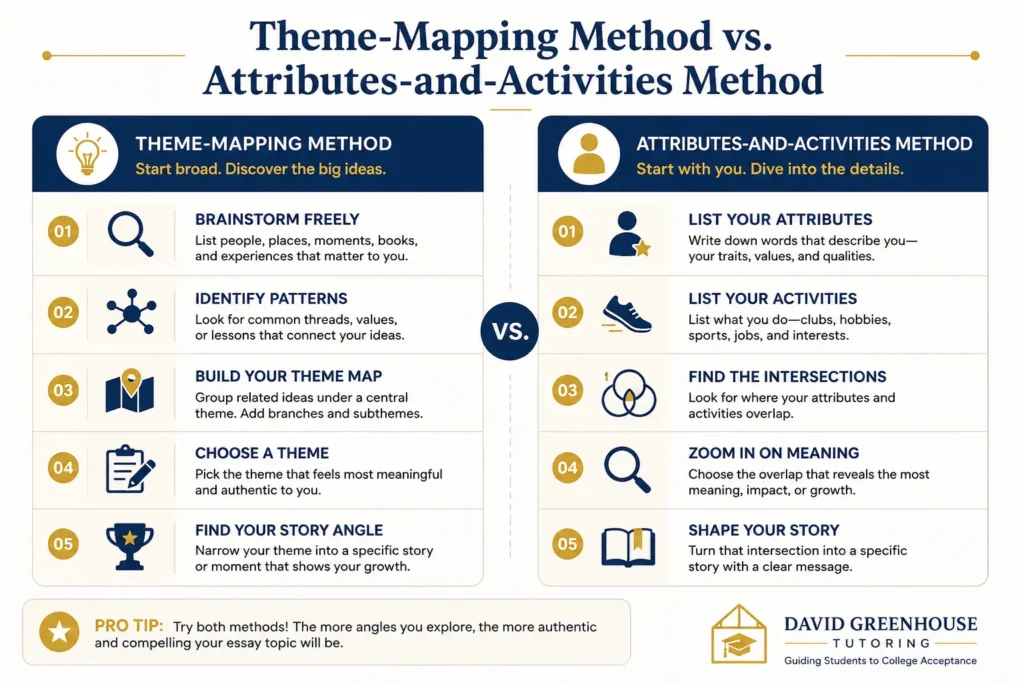
Every student processes their own life differently. Some think in themes and emotional throughlines. Others think in lists, categories, and concrete facts. Neither is better, but using the wrong one for your brain is exactly why “just brainstorm” advice fails so many students.
Method 1: The Theme-Mapping Method
This method works best for students who are naturally reflective, the ones who can talk for twenty minutes about why something matters to them once someone asks the right question.
How it works:
- Start with an open conversation, not a worksheet. Talk through your last four years out loud: school, home, friendships, setbacks, routines.
- Notice what you keep circling back to without being asked. That repetition is a signal, not a coincidence.
- Identify two or three themes hiding underneath the specific stories: patience, control, belonging, curiosity, responsibility.
- Pick the one theme that shows up in more than one part of your life, then find the single smallest, most specific moment that captures it.
This is the approach one of our students used to turn a passion for fashion design and a handful of personal challenges into an essay woven around a single physical image: the fabric of who she was becoming. She didn’t write about “overcoming adversity.” She wrote about noticing a pattern in her own life and naming it.
Another student kept coming back to the same small detail in every conversation: he always ended up being the one who fixed things, a bike chain, a broken sibling argument, a group project that was falling apart. Once we named “quiet problem-solving” as his theme, the essay wrote itself around the summer he rebuilt the same bike three times rather than buying a new one.
Method 2: The Attributes-and-Activities Method
This method works best for students who think more analytically, the ones who find open-ended reflection frustrating and want something concrete to build from.
How it works:
- Make two separate lists: one of personal attributes (patient, competitive, detail-obsessed, stubborn, protective of younger siblings), and one of activities or commitments that actually held your attention (not just what looks good on paper).
- Cross-reference the two lists. Look for an attribute and an activity that repeatedly show up together.
- Group the matches into two or three possible themes.
- Build the essay around the specific moment where that attribute and that activity intersected most clearly, not the whole four-year history of the activity.
This method was built for exactly the students who say, “I don’t have one big story, I have a bunch of small ones.” That’s not a disadvantage here. It’s the raw material.
Here’s how it plays out in practice: a student lists “protective of younger siblings” on one side and “coaches a youth soccer team” on the other. Those two facts alone don’t mean much. But cross-referenced, they point to a single afternoon when a nine-year-old on her team refused to leave the bench after a bad play, and she had to decide, on the spot, whether to push him or let him sit it out. That decision, not the four years of coaching, became her essay.
Which Method Fits You? A 60-Second Self-Test
Answer honestly:
- Do you think out loud better than you think on paper? → Start with Theme-Mapping.
- Do you prefer a checklist over an open question? → Start with the Attributes-and-Activities Method.
- Have you already tried “just brainstorm” and gotten nowhere? → That’s normal. Both methods above exist because open-ended brainstorming fails most students. It needs structure, not more time.
- Do you have one clear moment you keep almost writing about, then talking yourself out of? → That’s very likely your topic. The method is just how you prove it to yourself.
Curious which camp you fall into? Most students find out within the first ten minutes of a free 15-minute call, just from how they answer the first question.
What Makes an “Ordinary” Topic Actually Work
Not every everyday moment becomes a strong essay. The ones that do share three things in common. Compare the two sides below and notice the difference isn’t the event itself, it’s what the writer does with it.
| Works | Doesn’t Work |
|---|---|
| A specific, small moment (folding laundry with a grandparent, fixing the same bike chain three summers in a row) | A broad summary of an entire activity or four-year commitment |
| Shows how you think or make decisions | Just states a trait (“I am hardworking”) without proof |
| Reveals something a transcript can’t | Repeats what’s already listed in your activities section |
| Has one clear, honest emotional throughline | Tries to cover three unrelated ideas in 650 words |
If you can explain, in one sentence, what a stranger would learn about how your mind works from your topic, and it isn’t something they could learn from your GPA, you likely have a workable essay.
A Simple Timeline for Juniors and Seniors
- Spring/Summer of Junior Year: Have the brainstorming conversation. Choose a method. Land on 2 to 3 possible topics.
- Early Summer: Draft one topic fully before touching the others. A finished rough draft tells you more than three half-started ones.
- Late Summer: Revise for voice, not just grammar. The essay should sound like you talking, not like a template.
- Early Fall of Senior Year: Final polish, well before the first application deadline hits.
Starting during junior year, rather than the fall of senior year, is what gives students room to throw out a topic that isn’t working without panicking about the calendar. Families in Hackettstown and across Warren County typically start this conversation the spring before senior year for exactly that reason.
When to Get a Second Set of Eyes
Some students genuinely do land on a strong topic through either method on their own. Others get to a list of options and can’t tell which one is actually the strongest, which is exactly the moment an outside, experienced reader is worth the most. If you’ve been through the Theme-Mapping or Attributes-and-Activities process and still aren’t sure your topic is working, that’s a fifteen-minute conversation, not a bigger problem.
David Greenhouse has walked more than 275 students individually through this exact process over 20+ years working with families across Hackettstown, Warren County, and Morris County, New Jersey. Students who’ve worked with him on essays specifically have gone on to Cornell, UPenn, Rutgers, Lehigh, Villanova, and Penn State. You can read how the process worked for other families on the testimonials page.
If you’re stuck on a topic right now, the fastest next step is a free 15-minute call to talk through what you’ve already got and figure out, together, whether you’re closer to a topic than you think.
FAQs: Finding a College Essay Topic When Your Life Feels Ordinary
Q: What if I really have no extracurriculars or achievements to draw from? A: The essay isn’t a résumé. A daily habit, a chore, or a small family responsibility works just as well as an activity.
Q: Can a small, everyday moment actually make a strong essay topic? A: Yes. Small moments examined closely usually make stronger essays than big events summarized broadly.
Q: How do I know if my topic is too boring? A: If it only restates your activities list without showing how you think or decide, it needs a narrower focus, not a new topic.
Q: Should I write about a hobby nobody else has? A: Only if it reveals something about you beyond the hobby itself, the “why,” not just the “what.”
Q: When should I start brainstorming my college essay? A: Spring or summer of junior year, so you have time to change direction if a topic isn’t working.
Q: Is it bad to write about something “normal,” like family or school? A: No. Familiar subjects are fine as long as the specific angle and insight are yours alone.
Q: What if I can’t tell which of my topic ideas is strongest? A: That’s the exact point where a second, experienced reader saves the most time. A short call is usually enough to tell.

About the Author
David Greenhouse
Founder of David Greenhouse Tutoring in Hackettstown, New Jersey. For over 20 years, David has personally worked with more than 4,000 students across Northern and Central New Jersey and Rockland County, NY, privately tutoring over 275 children and guiding more than 75 families through the complete college application process, including essays, interviews, and recommendation letter strategy. His students have been admitted to Cornell, UPenn, Rutgers, Lehigh, Villanova, Penn State, and other top universities.
More about David’s background and approach →