
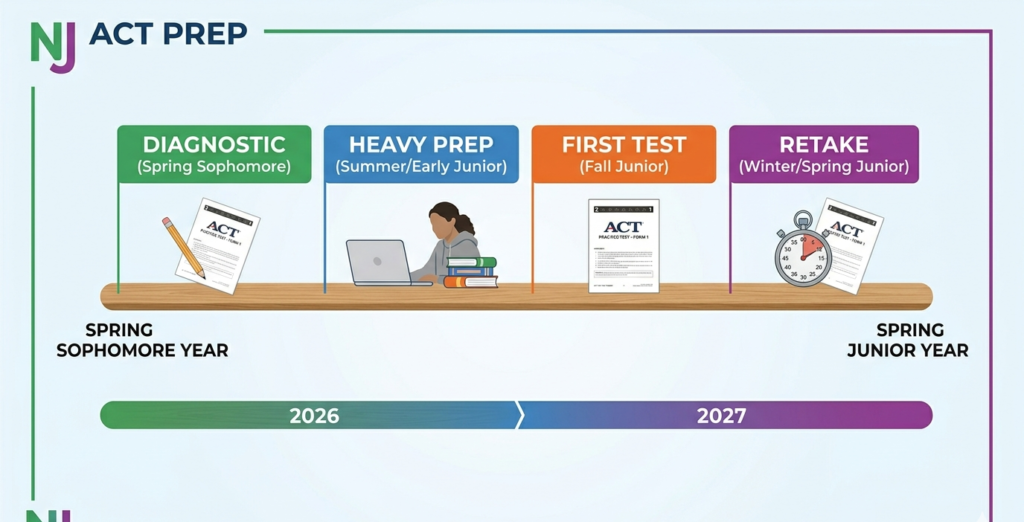
Most NJ students should begin ACT prep in the spring of sophomore year or the summer before junior year, leaving 6–12 months before their first official test. Sophomores benefit from light, foundational practice, while juniors should follow a structured 3–4 month plan timed around fall or spring test dates — early enough to retake the ACT if needed before college applications are due.
Introduction:
Here is something most NJ families do not realize until it is too late: the ACT is not just a test. It is a timed project. And like any project, starting earlier gives you more room to do it right.
New Jersey high schools produce some of the most prepared students in the country. But they also come with some of the heaviest workloads — AP classes, varsity sports, extracurriculars, and a college process that feels like it starts the moment you walk into 9th grade. Add the fact that NJ has one of the highest student-to-counselor ratios in the country, and it becomes clear why so many families feel behind.
The good news is this: if your child is a sophomore or junior right now, there is still plenty of time. But the window to act without stress is smaller than most parents think. This guide breaks down exactly when to start, what to do each month, and how NJ students specifically should plan their ACT prep timeline for 2026 and beyond.
What Is the ACT, and Why Do NJ Students Take It?
The ACT is a college readiness exam scored on a scale of 1 to 36. It tests four main areas:
| Section | Questions | Time |
| English | 75 questions | 45 minutes |
| Mathematics | 45 questions | 50 minutes |
| Reading | 36 questions | 35 minutes |
| Science | 40 questions | 35 minutes |
| Writing (Optional) | 1 essay | 40 minutes |
Most four-year colleges — including Rutgers, Lehigh, Villanova, and Penn State — accept both the ACT and the SAT equally. NJ students often try both and submit whichever score is stronger.
There is also a very NJ-specific reason to take the ACT seriously: under New Jersey’s graduation requirements, an ACT score that meets the state’s cut score can serve as a substitute pathway if a student does not pass the NJGPA (New Jersey Graduation Proficiency Assessment) in 11th grade. That gives the ACT a double purpose for NJ students.
When to Start ACT Prep: The Simple Answer for NJ Families
For sophomores: Start prep in the spring of 10th grade or the summer before 11th grade. For juniors: If you have not started yet, start right now — fall or winter of junior year is your window.
Here is what the experts and data consistently show:
- Starting in the summer between sophomore and junior year gives students the most time with the least stress.
- Students who begin structured prep early improve their scores by 4 to 6 points more on the ACT than students who start late.
- Cramming in the final weeks before the test is one of the least effective strategies for this exam.
Think of it like learning to ride a bike. Reading about it is not enough — you need practice over time, and falling down a few times is part of the process.
The Full 2026 ACT Prep Timeline for NJ Sophomores and Juniors
For NJ Sophomores (Class of 2028)
Spring of Sophomore Year (March – May 2026) — Build Your Foundation
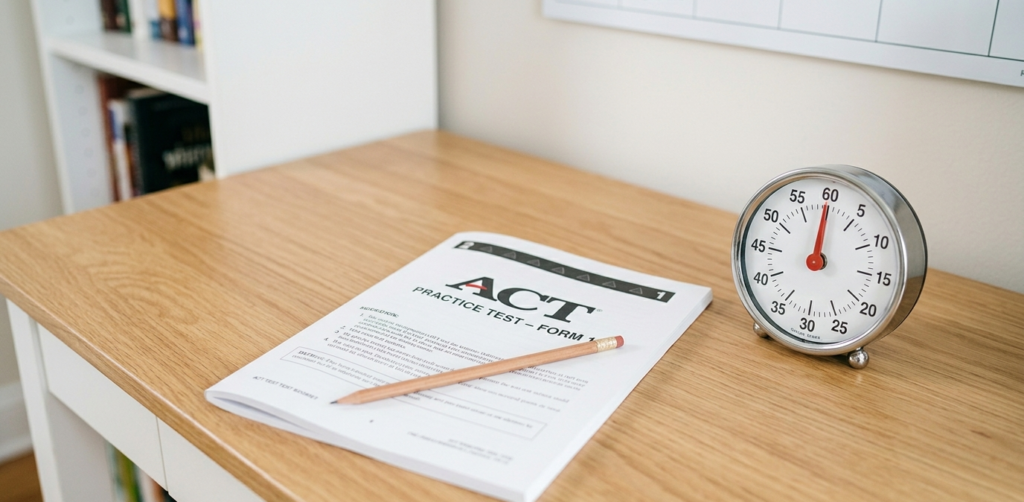
This is the ideal time to take your first diagnostic ACT practice test. You are not going for a great score here — you are trying to understand where you stand.
What to do:
- Download a free official ACT practice test from ACT.org
- Take it under real-time conditions
- Review the results section by section
- Identify which areas need the most work (English, Math, Reading, or Science)
- Begin light prep: 1 to 2 hours per week on weak areas
At this stage, you do not need a tutor yet. You need to know your baseline.
NJ-specific note: Spring of sophomore year is also when many NJ students take AP exams and NJSLA assessments. Do not let ACT prep compete with these. Keep the workload light and consistent.
Summer Before Junior Year (June – August 2026) — Your Golden Window
This is the single best time for ACT prep, and most expert sources agree on it. No school. No AP exams. Fewer commitments.

What to do:
- Begin a structured prep program (self-study, online course, or private tutoring)
- Aim for 5 to 8 hours of focused prep per week
- Take at least two full-length timed practice tests
- Work through official ACT prep materials
- Focus deeply on your weakest section
- If English or Reading is your weak spot, consider working with a specialist — this is where targeted one-on-one help pays off most
Why this window matters: Students who prepare seriously during this summer often walk into the fall of junior year ready to take their first official ACT. That means you have the entire junior year for retakes if needed — without any pressure.
For NJ Juniors (Class of 2027)
Fall of Junior Year (September – November 2026) — Take Your First Official ACT
This is the most popular time for NJ students to take the ACT for the first time. The September and October test dates are excellent first targets.
Why is the fall of junior year the most common first test:
- You have completed most of your core high school coursework
- You have the entire junior year for retakes if the score is not where you want it
- Fall scores arrive in time to guide your college list before winter
What to do:
- Register for the September or October 2026 ACT (register at least 4 to 5 weeks in advance to secure your preferred test center)
- Continue prep with practice tests, reviewing previous errors each time
- Focus on timing strategies — many NJ students lose points not because they do not know the material, but because they run out of time
- Work on question-type recognition: the ACT English and Reading sections repeat the same types of questions across every single test
Winter of Junior Year (December 2026 – February 2027) — Review and Retake
After your first official score comes back, you will know exactly what to focus on for a retake.
What to do:
- Review your Test Information Release (TIR) if available — this shows your actual questions and answers
- Identify the specific question types that cost you the most points
- Adjust your prep strategy based on real data, not guesses
- Register for the February or April 2027 ACT retake
Most students who improve their ACT scores do so on their second or third attempt — not their first.
Spring of Junior Year (March – May 2027) — Retake and Finalize
The April test date is a favorite among NJ college counselors. By the spring of junior year, you have had months of preparation and at least one real test experience behind you.
What to do:
- Take your retake ACT (February or April 2027)
- Aim to have a score you are happy with by the end of junior year
- Begin building your college list using your real ACT score — not a hoped-for future score
- If your score is strong, consider whether any further prep is worthwhile before the fall of your senior year
By the end of junior year, you should have a solid ACT score in hand. That frees up senior fall for college applications, essays, and everything else — without test stress hanging over you.
Month-by-Month ACT Prep Timeline for NJ Students (2026–2027)
| Month | Sophomore Tasks | Junior Tasks |
| March 2026 | Take a diagnostic practice test | Continue or begin structured prep |
| April–May 2026 | Light prep, 1–2 hrs/week | Register for the September ACT |
| June–August 2026 | Heavy prep, 5–8 hrs/week (golden window) | Prep intensively for the fall test |
| September 2026 | Optional: take the first ACT as practice | Take the first official ACT |
| October 2026 | Continue prep lightly | Take the ACT if not taken in September |
| November–December 2026 | Rest and maintain skills | Review TIR scores, plan retake |
| January–February 2027 | Begin junior year prep planning | Register for the April retake |
| March–April 2027 | Take the first official ACT | Take the ACT retake |
| May–June 2027 | Evaluate score and college list | Finalize score, build college list |
Why NJ Students Specifically Need to Start Earlier
New Jersey is one of the most competitive states in the country for college admissions. Here is what makes the NJ context unique:
1. High competition from within the state. NJ students are competing against classmates from schools with rigorous academic programs. An average national score may not be competitive when your high school sends 20 students to the same college.
2. Poor student-to-counselor ratios. New Jersey has approximately 370 students per school counselor — one of the worst ratios in the country. Most students in Warren County, Morris County, and across Northern NJ receive very little individualized guidance. This means the responsibility for building a smart ACT timeline falls on families themselves.
3. A packed junior year. NJ juniors often face AP exams, NJGPA testing, and heavy course loads all at once. Starting ACT prep before junior year begins means you are not trying to squeeze prep into an already full schedule.
4. Early college application deadlines. Many competitive NJ students apply Early Decision or Early Action in October or November of senior year. To do that comfortably, you need your ACT score locked in by summer before senior year at the latest.
How Many Hours of ACT Prep Does Your Child Actually Need?
The honest answer: it depends on where they start and where they want to go.
| Starting Score | Target Improvement | Recommended Prep Hours |
| Below 20 | 4+ points | 150+ hours |
| 20–24 | 3–4 points | 80–150 hours |
| 25–28 | 2–3 points | 40–80 hours |
| 29–32 | 1–2 points | 20–40 hours |
These are not hours of passively reading prep books. They are hours of active practice — timed tests, reviewing mistakes, working on specific question types, and building pacing skills.
A structured tutoring program that focuses on your child’s actual weak spots is almost always more efficient than self-study alone. Eight focused weeks of targeted prep can deliver better results than four months of random studying.
What to Focus On During ACT Prep?
ACT English (75 questions, 45 minutes)
This is where preparation makes the clearest difference. The English section tests grammar, punctuation, sentence structure, and style — the same concepts repeated across every test. Students who learn to recognize question types quickly stop treating every question as new and start answering with speed and confidence.
Main skills to build:
- Punctuation rules (commas, semicolons, apostrophes)
- Sentence structure and fragments
- Transition logic
- Concise and tone
ACT Reading (36 questions, 35 minutes)
Timing is the biggest challenge here. Students have roughly 35 seconds per question — and many run out of time by the third passage. The fix is not reading faster. It is reading smarter.
Main skills to build:
- Active reading strategy (annotating while reading)
- Identifying the main idea quickly
- Paired passage comparison questions
- Evidence-based answer selection
ACT Math (45 questions, 50 minutes)
Math covers arithmetic through pre-calculus, with Algebra 2 being the most heavily tested area. Students who have completed Algebra 2 before starting prep have a significant advantage.
Main skills to build:
- Algebra 1 and 2 fluency
- Coordinate geometry
- Trigonometry basics
- Calculator-efficient problem solving
ACT Science (40 questions, 35 minutes)
Despite the name, this section is really a data interpretation test. Most questions involve reading graphs, charts, and tables — not recalling science facts.
Main skills to build:
- Graph and data interpretation
- Comparing conflicting viewpoints
- Identifying variables and controls
- Speed skimming for relevant data
The PSAT and Its Connection to ACT Prep in NJ
Many NJ families treat the PSAT (taken in October of junior year) as a harmless practice run. For most students, that is true. But for juniors with strong English scores, it is also the qualifying exam for the National Merit Scholarship, and the score is built or lost in the English and Reading sections.
If your child is a strong English student, taking PSAT preparation seriously in the fall of junior year has two benefits: it sharpens the reading and writing skills that carry directly over to the ACT, and it creates a real opportunity for scholarship recognition that many NJ families miss simply because they did not know it was worth their attention.
Common ACT Prep Mistakes NJ Students Make (and How to Avoid Them)
Mistake 1: Starting too late. Waiting until spring of junior year — or worse, senior fall — means rushed prep, higher stress, and fewer options if the score needs improvement.
Mistake 2: Relying only on books and apps. Self-study works for some students. But without structured feedback, many students practice the same mistakes over and over without knowing it. Getting specific, expert feedback on your actual errors is what creates real improvement.
Mistake 3: Ignoring timing and pacing. Most NJ students who underperform on the ACT do not fail because they lack knowledge. They fail because they run out of time. Pacing is a skill that must be trained, not assumed.
Mistake 4: Skipping full-length practice tests. Doing mini-drills is helpful. But students who never sit through a full 3-hour timed practice test are not preparing for the experience of test day. Full-length tests build stamina and reveal real-world pacing issues.
Mistake 5: Planning to retake in the senior fall without a buffer. If a student’s only remaining ACT attempt is in October of senior year and they are applying Early Decision in November, there is no room to recover from a disappointing score. Building in a buffer earlier is always smarter.
When Is It Too Late to Start ACT Prep in NJ?
Short answer: it is never truly too late, but the later you start, the fewer options you have.
If your child is a junior now and has not begun prep, start immediately. A focused 8 to 12 week intensive program before the April or June test is absolutely achievable and can produce meaningful improvement.
If your child is already a senior, ACT prep is still possible, but you are working with a very tight window. The September and October senior year test dates are the last realistic opportunities before most college application deadlines. You need to start prep now, not in a few weeks.
Senior year testing makes most sense for students who are improving an already solid score, not trying to build a foundation from scratch under pressure.
How David Greenhouse Tutoring Helps NJ Students With ACT Prep
At David Greenhouse Tutoring, we have spent over 20 years working one-on-one with students across Hackettstown, Warren County, Morris County, and all of Northern New Jersey. We have seen firsthand how the timing and structure of ACT prep changes outcomes.

Here is what makes our approach different:
- Every session is with David personally. No junior tutors, no rotating staff, no handoffs. When your child sits down to prep, they work directly with the same experienced specialist every single time.
- We focus on the English, Reading, and Writing sections. These are the sections where targeted preparation makes the most direct and immediate difference to the final score.
- We address pacing in the very first session. Most programs spend weeks on content before touching timing. We address it from day one — because timing is where most NJ students lose points.
- We build plans around your child specifically. Not a standard curriculum from a shelf. A focused program that starts from exactly where your child is right now and targets the gaps that are actually holding them back.
- Students who work with us have gone on to Cornell, Penn, Rutgers, Lehigh, Villanova, Penn State, and many other top universities.
If you are reading this and wondering whether there is still time for your child, the answer is almost always yes. But the right time to reach out is now, not later.
There is no commitment and no pressure. It is a straightforward conversation to find out where your child stands, what a realistic timeline looks like, and whether working together is the right fit.
Final Word: Stop Waiting, Start Planning
The families who feel the most confident during the college process are not the ones who scrambled at the end. They are the ones who made a plan early, stuck to it, and let time do the work.
For NJ sophomores and juniors, the time to build that plan is now — not when junior year gets frantic, and not when college application season suddenly feels very real.
Whether you are just beginning to think about ACT prep or you are already behind and looking for a fast, focused way to catch up, the next right step is a simple conversation.
→ Book Your Free 15-Minute Call with David Greenhouse Today. No pressure. No commitment. Just a clear, honest look at where your child stands and what it would take to get them where they want to go.
Frequently Asked Questions: ACT Prep Timeline for NJ Students
1. When should a sophomore start ACT prep in NJ?
Spring of 10th grade or summer before junior year is ideal — it gives you the most time with the least stress.
2. When should a junior start ACT prep in NJ?
Start immediately. The fall of junior year is your first realistic test date, and prep should begin 8 to 12 weeks before that.
3. What is the best month for the ACT in New Jersey?
September and October of junior year are the most popular and strategic first test dates for NJ students.
4. Can a sophomore take the ACT in New Jersey?
Yes. Taking the ACT as a sophomore provides a useful baseline score and early insight into which areas need the most work.
5. How long should ACT prep take?
Most students need 8 to 16 weeks of structured prep. Students aiming for larger score jumps may benefit from a longer timeline.
