
Written by David Greenhouse, College Prep Tutor | Hackettstown, NJ | Serving Warren County and New Jersey families since 2010 | 4,000+ students helped
Quick Answer: The SAT and ACT are both accepted equally by every major college in the United States. The right test is simply the one where your child scores higher. The fastest way to find out is to take one official practice test for each — then compare scores and how each test felt. If your child is strong in math and prefers focused reading, the SAT is usually the better fit. If they read quickly, handle science data well, and perform under time pressure, the ACT tends to work better. This guide walks New Jersey parents through everything they need to make the right decision for their child in 2026.
Every year, families across Hackettstown, Washington, and Warren County face the same question. SAT or ACT — which test should my child take?
Both tests open the same doors. But they are not the same test. Choosing the wrong one — or not choosing deliberately at all — is one of the most common and most avoidable mistakes families make in the college prep process.
As a college prep tutor serving New Jersey families, I have worked with more than 4,000 students on exactly this decision. Here is what I have learned about matching the right test to the right student.
What Is the SAT in 2026?
The SAT is made by the College Board and tests reading, writing, and math.
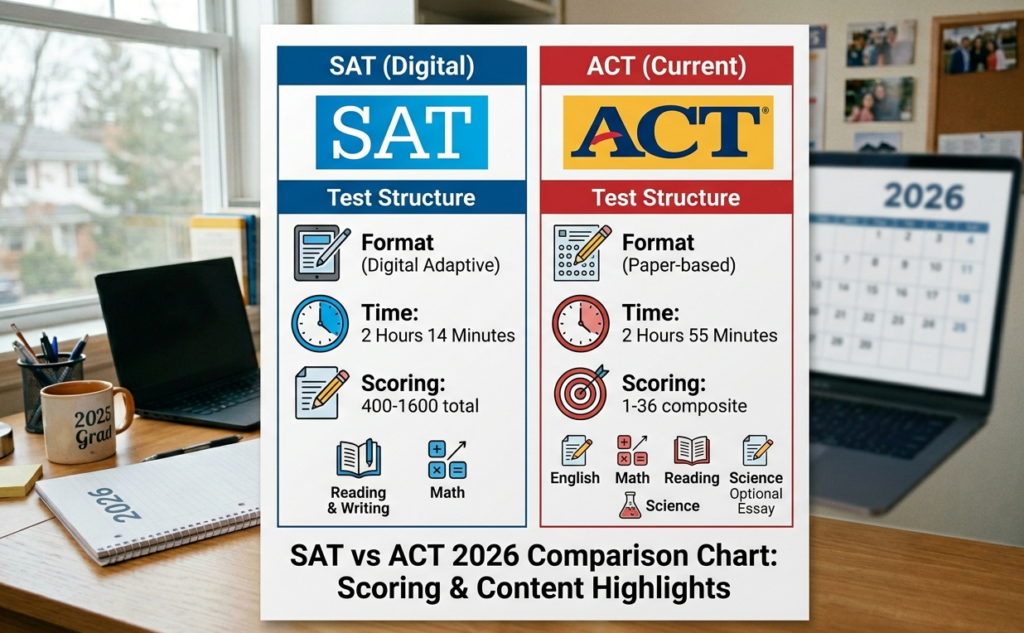
As of 2024 the SAT went fully digital. Students now take it on a computer or tablet in approximately 2 hours and 14 minutes — significantly shorter than before.
SAT scores run from 400 to 1600. For most competitive four-year colleges, you are targeting 1100 or above. For top schools — think Rutgers Honors, Lehigh, Villanova — you want 1300 or higher.
The SAT is available at test centers across New Jersey including locations in Morris County, Sussex County, and Warren County. New Jersey students can also access free official SAT prep through Khan Academy.
What Is the ACT in 2026?
The ACT is made by ACT, Inc. and tests English, math, reading, and science.
The ACT remains mostly paper-based in 2026, though digital options are increasingly available. It runs approximately 2 hours and 55 minutes without the optional writing section.
ACT scores run from 1 to 36. A composite score of 21 is competitive for most four-year colleges. A score of 30 or above puts your child in strong contention for selective schools.
SAT vs ACT 2026: Key Differences at a Glance
| Feature | SAT | ACT |
|---|---|---|
| Made by | College Board | ACT, Inc. |
| Test length | ~2 hr 14 min | 2 hr 55 min |
| Score range | 400–1600 | 1–36 |
| Format | Fully digital | Mostly paper |
| Subjects tested | Reading, Writing, Math | English, Math, Reading, Science |
| Science section | No | Yes |
| Calculator use | All math sections | One math section |
| Optional essay | Not available | Optional |
| Accepted by colleges | Yes — all major US colleges | Yes — all major US colleges |
The 4 Biggest Differences Between SAT and ACT
1. The Science Section
The ACT has a science section. The SAT does not. But here is what most families do not realise — the ACT science section does not test memorised science facts.
It tests your child’s ability to read charts, graphs, and experimental data. Students who are analytical and comfortable interpreting data tend to handle this section well, regardless of how much they know about biology or chemistry.
If your child genuinely dislikes anything science-related and struggles to read data quickly, the SAT’s lack of a science section is a meaningful advantage.
2. Math Focus
The SAT puts a significantly heavier emphasis on math. Roughly half of the total SAT score comes from the math section, with a strong focus on algebra, problem-solving, and data analysis.
The ACT math section covers more ground — including trigonometry — but carries less overall weight in the final score. For students who are strong in math, the SAT rewards that strength directly. For students who are weaker in math, the ACT’s more balanced structure can work in their favour.
3. Reading Style and Pacing
Both tests have reading sections but the experience feels different. The SAT asks questions in sequence and ties them closely to specific parts of the passage. Students who read carefully and methodically tend to do well.
The ACT reading section moves faster with more passages to cover in less time. Students who read quickly and confidently — who can scan efficiently without losing comprehension — are usually better suited to the ACT format.
4. Time Pressure
This is the difference most students feel most acutely. The ACT gives fewer seconds per question across every section. Students who think slowly and carefully — who need time to be sure before committing to an answer — almost always perform better on the SAT.
Students who work quickly and trust their first instinct tend to thrive on the ACT’s pace.
Which Test Is Easier — SAT or ACT?
Neither test is objectively easier. The right answer depends entirely on your child.
The “easier” test is the one that plays to your child’s specific strengths. Here is a practical guide:
| Your child’s strength | Better fit |
|---|---|
| Strong in math and algebra | SAT |
| Reads fast, works quickly | ACT |
| Thinks carefully, prefers more time | SAT |
| Dislikes science topics | SAT |
| Strong in grammar and writing | ACT |
| Comfortable with data and graphs | ACT |
| Needs accommodations for extra time | SAT (fewer questions overall) |
The most reliable way to find out is to sit your child down with one official practice SAT and one official practice ACT — under real timed conditions — and compare both the scores and how each test felt to take.
In my experience working with New Jersey students, the test that feels more manageable is almost always the test where the student ultimately performs better.
Should My Child Take the SAT or ACT? A Step-by-Step Plan
Here is the exact process I walk Warren County and New Jersey families through when making this decision.
Step 1: Download one official free practice SAT from the College Board website and one official free practice ACT from the ACT website.
Step 2: Set aside a quiet Saturday morning for each test — full timed conditions, no interruptions.
Step 3: Score both tests and convert the scores to a common scale so you can compare them directly.
Step 4: Ask your child which test felt more natural and less stressful. That feeling is meaningful data.
Step 5: Look up the average SAT and ACT score ranges for the colleges on your child’s list. New Jersey students targeting Rutgers, Lehigh, Villanova, Penn State, or Cornell should know those target ranges before choosing.
Step 6: Choose the test where your child scored higher or felt more confident — whichever gap is larger.
Step 7: Build a prep plan at least 3 to 6 months before the target test date. For most New Jersey juniors, this means starting no later than September of junior year for a spring test.
SAT vs ACT Scoring Explained
SAT Scoring
The SAT has two sections — Evidence-Based Reading and Writing, and Math. Each scores between 200 and 800, giving a total range of 400 to 1600. There is no penalty for wrong answers, so your child should always answer every question even when uncertain.
ACT Scoring
The ACT has four sections — English, Math, Reading, and Science — each scored between 1 and 36. The final composite score is the average of all four sections. Like the SAT, there is no penalty for wrong answers.
Five Mistakes I See New Jersey Families Make Every Year
1. Picking the test based on what their friends are taking
Whatever test the older sibling, the lacrosse captain, or the friend group is taking has nothing to do with which test fits your child. I have seen perfectly capable students lose 80 to 120 points choosing the SAT because that is what their high school pushes, when their brain is wired for the ACT. Run the diagnostic. Pick by score, not by social proof.
2. Treating the digital SAT like the old paper SAT
The 2024 SAT redesign was not cosmetic. The reading passages got shorter, the questions got more direct, the math interface changed entirely. Old prep books and old online courses are actively misleading your child. If a tutor or program is still using pre-2024 SAT material, you are paying to learn the wrong test.
3. Underestimating the English and Reading sections
Most families assume math is the hardest part. For the majority of NJ students I work with, the points they leave on the table are in Reading, Writing, and English — not math. The reason is simple: most schools never explicitly taught test-style grammar or test-style reading. They taught literature and creative writing, which are different skills entirely.
4. Studying volume instead of studying patterns
I have had students walk in having taken twelve practice tests with no score movement. They were practicing wrong things repeatedly. The score moves when the student sees the specific question type they are missing, understands why they keep missing it, and replaces the wrong habit with a correct one. Volume without diagnosis is just expensive cardio.
5. Waiting until junior year to start
By the time some families call me in March of junior year, the runway is too short to do the work properly. Sophomore spring or summer-before-junior-year is the right window to start serious prep. Earlier is better — not for the test itself, but for the time it gives us to fix the right things.
What Is a Good Score for New Jersey Students?
Target scores depend on your child’s college list. For most four-year colleges in New Jersey and the mid-Atlantic region, a score of 1100 on the SAT or 21 on the ACT is competitive for admission.
For selective schools — Rutgers Honors Program, Lehigh, Villanova, Penn State Schreyer, Cornell — you are targeting 1350+ on the SAT or 30+ on the ACT.
Always check the specific score ranges for each school on your child’s list. Those numbers matter more than any general benchmark.
How David Greenhouse Helps New Jersey Students Choose and Prepare

Choosing the right test is the first step. Preparing specifically for that test’s structure, timing, and question logic is what actually moves the score.
I work one-on-one with students across Hackettstown, Warren County, and New Jersey on SAT prep and ACT English tutoring — identifying exactly where a student’s score is being held back and rebuilding from there.
The average improvement across my students is 90 points on the English sections of either test. That kind of movement does not come from more practice tests. It comes from understanding why the wrong answers are wrong and correcting the habits that keep producing them.
If you are not sure which test is the right fit for your child, or if your child has already been preparing and the scores are not moving, book a free 15-minute call and we can figure out exactly what is happening and what to do about it.
What This Looks Like for New Jersey Families Specifically
Whether you are in Warren County, Morris County, Sussex County, or anywhere else across New Jersey, the calculus for SAT versus ACT comes down to where your child is applying. Here is the score landscape at the schools my families ask about most often.
| New Jersey College | Middle 50% SAT | Middle 50% ACT | Test Policy 2026 |
| Rutgers–New Brunswick | 1270 – 1480 | 28 – 33 | Test-optional, scores accepted |
| TCNJ (College of New Jersey) | 1140 – 1340 | 26 – 31 | Test-optional (required for Nursing & 7-Year Med) |
| NJIT | 1210 – 1470 | 27 – 32 | Test-optional |
| Rutgers–Newark | 1060 – 1290 | 21 – 27 | Test-optional |
| Stevens Institute of Technology | 1370 – 1500 | 31 – 34 | Test-optional, strongly recommended |
| Princeton University | 1500 – 1580 | 34 – 35 | Test required again as of 2025 |
Two things stand out from this table that families miss. First, test-optional does not mean test-irrelevant. When my students submit strong scores to Rutgers or TCNJ, those scores often unlock honors program invitations and merit aid that would not otherwise show up. Second, several New Jersey schools — Princeton being the most public — have walked back test-optional. The trend is moving toward submission again, especially at selective institutions.
If your child is targeting Rutgers New Brunswick, Lehigh, Penn State, Villanova, or any school in that competitive band, a strong test score is still doing real work for the application. The question is just which test gets that strong score out of your child fastest.
I help students from Hackettstown, Long Valley, Mount Olive, Sparta, Newton, and across northwest New Jersey figure out which test fits their brain — usually within one diagnostic session. Come find out where your child stands.
→ Book a free consultation with David · Read what families say about working with David
Final Thoughts
The SAT vs ACT decision does not need to be stressful. Take one practice test for each. Compare the scores. Choose the test where your child performs better and feels more confident. Then prepare specifically and deliberately for that test.
For New Jersey families in Hackettstown, Washington, Long Valley, and across Warren and Morris Counties — if you want help making this decision or if your child’s scores are not moving despite consistent preparation — reach out for a free consultation. One conversation is usually enough to identify exactly what is happening and what to do next.
David Greenhouse is a college prep tutor based in Hackettstown, NJ, serving families across Warren County, Morris County, and New Jersey. He specialises in SAT prep, ACT English tutoring, college essay writing, and college application coaching. Over 4,000 students helped.
Can my child take both the SAT and ACT?
Yes. Many students take both tests and submit whichever score is stronger. This is a completely valid strategy and more common than most families realise. Some students discover they perform significantly better on one test — and knowing that early is worth the extra preparation time.
How many times can my child take each test?
Your child can take the SAT up to 12 times. The ACT has no official limit. Most students take their chosen test two to three times to achieve their best score. I generally recommend planning for two attempts with serious preparation between them rather than taking the test repeatedly without targeted changes.
Does the SAT or ACT matter more for scholarships?
It depends on the specific scholarship. Many scholarships in the Midwest and South are ACT-based. Most New Jersey and mid-Atlantic scholarships accept both equally. Always check the specific requirements for each scholarship your child is targeting.
Is the digital SAT harder than the paper SAT?
Most students find the digital SAT easier to manage than the previous paper version. The test is adaptive — meaning questions adjust to your child’s performance level — and the overall length is shorter. A strong start in each section leads to higher-value questions in the second half, which rewards preparation and confidence.
What if my child needs accommodations?
Both the SAT and ACT offer accommodations for students with documented learning differences, including extended time, separate testing rooms, and other supports. Apply through the College Board or ACT website well in advance — the application process takes time and must be completed before registration deadlines.
When should New Jersey students take the SAT or ACT?
Most New Jersey students take their first attempt in the spring of junior year — typically March through June. This allows time for one or two additional attempts in the fall of senior year if needed, while still meeting early decision and early action deadlines. Starting preparation in September of junior year is ideal for a March or May test date.
